
Early bird scholarship up to 30%
⚠ Alert: Offer available till 28th of November 2026
Get to know more about the MBA in Health Economics & Healthcare Management

Learning Formula
Online/On Campus

Intakes
April/October

Language
English
MBA in Health Economics and Healthcare Management
with European Global Institute of Innovation and
Program Details
The MBA in Health Economics and Healthcare Management is an European Qualifications Framework (EQF) Level 7 European Master degree designed for medical professionals, hospital administrators, and public health officials who want to master the business side of medicine. This is a strategic leadership degree, not a clinical training program.
Lectures are delivered Online/On Campus by Docenti Global Business School and the Academic Degree is awarded by European Global Institute of Innovation and Technology, Malta. This program allows you to earn a prestigious qualification accredited by the Malta Further and Higher Education Authority (MFHEA, Malta)without leaving your current role or relocating. It is built for busy professionals who want to lead healthcare transformation in the global village, leveraging global economic standards to improve patient outcomes and facilitate profitability.
Key Academic Facts
- Credits Weight: 90 ECTS (European Credit Transfer and Accumulation System).
- Award: MBA in Health Economics and Healthcare Management from European Global Institute of Technology and Innovation, Malta.
- Professional Certificate of LifeLong Learning in Health Economics and Healthcare Management.
- Academic Level: Level 7 Master’s Degree (European Qualifications Framework).
- Duration: 12 to 18 Months.
- Format: Online, On Campus (No visa or relocation required).
- Accreditation: Fully accredited by the Malta Further and Higher Education Authority (MFHEA,
Malta) and evaluated by WES and recognized internationally. - Special Scholarship Discount up to 30% off Eligible tuitions fee
- Tuition: ₦4,500,000.00
Program Journey
From Pre-Master to Graduation
How students progress through the MSc – from the Pre-Master's to the classes and coursework, capstone defense and finally the certificate issuance
1
2
3
4
1
Pre-Master Courses (BLEP)
- Data Analysis for Managers
- AI for Business and innovation
- AI for Researchers
- Critical and Reflective Practice
- Online Business Education
- Academic Coaching
- Language Classes
- Webinars and Workshops
2
Didactic Activities
- Live proficiency sessions with industry experts
- Capstone Grouping
- Self study on recorded sessions and class materials
- Assessments and project submissions
- Townhall Meetings with program coordinator/Director
- Company Visits
- Study tours
3
Capstone project
- Project Development
- Program Director supervision and reviews
- Mock defense and defense preparation
- Capstone Project defense with colleagues
4
Graduation and Certification
- Final Transcript and result issued
- Graduation Ceremony (Malta and Lagos)
- Master's Certificate issued
Explore the Programme
Tap any Button below to explore our Programme Guide.
- Why Choose Us?
- Programme Benefits
- Learning Outcomes
- Engaging Program Content
- Learning Support
- Program Structure
- Accreditations of the EU Global to the program
- Program Awarding Institutions and Title
- Program Completion
- Career Pathways
- Faculty
- Bridging Medicine and Markets: Move beyond clinical practice into senior health administration, where you manage budgets, policy, and large-scale healthcare delivery.
- European Standards, Local Impact: Gain a global degree in Health Economics while staying in Nigeria. You avoid the massive “relocation tax” and instead invest in your career growth right where you are.
- Data-Driven Leadership: Learn to use economic modeling and health data to make high-stakes decisions that ensure the sustainability of hospitals and health agencies.
- Credential Without Interruption: You don’t have to pause your medical career. Study at your own pace and apply new management strategies to your facility the very next day.
Research-Based Capstone Project & Quality Supervision (ISO9001:2015)
This 90 ECTS program focuses on case study-based healthcare management systems, ensuring that every administrative decision is backed by credible data.
- Specialized Supervision: You are paired with supervisors who understand both the clinical and economic aspects of healthcare, providing expert guidance on your final research project.
- Policy and Practice: We move you past theory. Your research will focus on solving actual bottlenecks in health delivery, from pharmaceutical supply chains to hospital resource allocation.
- International Rigor: Your final project is held to European standards, proving you can manage healthcare systems at an international level of excellence.
Core Research & Specialization Areas
Candidates focus their research on high-impact sectors, including:
- Health Technology Assessment (HTA): Evaluating the cost-effectiveness of new medical technologies and drugs.
- Sustainable Health Financing: Designing models for universal health coverage and private insurance in emerging markets.
- Epidemiology & Resource Management: Using data to optimize hospital response during health crises.
- Healthcare Policy & Ethics: Navigating the legal and ethical complexities of modern health administration.
Programme Benefits
- Designed for Experienced Professionals: Tailored for executives aged 25 and above with at least two years of professional experience, making it an ideal mba degree program for emerging leaders in healthcare.
- Prestigious & Globally Recognized Qualification: Earn an internationally respected degree with WES recognition, fully accredited by the Council for Higher Education Development (USA) and approved by the MFHEA.
- Accredited & Globally Benchmarked: Awards 90 ECTS credits recognized as a Level 7 healthcare management degree under both the Malta Qualifications Framework (MQF) and European Qualifications Framework (EQF).
- International Exposure & Networking: Gain global immersion and business matching opportunities across Portugal, Spain, Thailand, Kigali, China, Malta, and Canada to build a global healthcare network.
- Practical, Implementation-Based Learning: Focuses on applied, collaborative strategies directly applicable to executive decision-making within modern healthcare and management environments.
- AI Literacy & Digital Readiness: Equips graduates with data-driven decision-making and AI applications essential for leading modern health systems in the industry 4.0 era.
- Innovative Learning Methodologies: Integrates case-based learning and storytelling to connect complex theories with real-world leadership challenges in health management.
- Flexible Financial Options: Offers accessible, flexible payment structures designed to support working professionals pursuing an advanced degree.
- Lifetime Learning Resources: Provides lifetime access to digital resources, course materials, and videos via the Docenti LMS, along with complete access to the E-Campus and E-Library of the European Global Institute of Innovation & Technology.
- World-Class Faculty: Taught by an international faculty bringing over 20 years of combined academic and industry expertise to every session.
- Real-World Case Studies: Uses global healthcare case studies to sharpen strategic thinking and practical policy analysis—key pillars of a top-tier MBA in health economics.
- Graduate Success & Reputation: Consistently rated exceptionally high by alumni for career acceleration, operational flexibility, and educational impact.
- Recognized European degree (Double Certification)
- 12 Months Duration
- Early Bird scholarship is available(up to 30%)
- Assess innovation and entrepreneurship opportunities in the world of Media & Entertainment
- Establish & Accelerate your career in Media & Entertainment and internship opportunities in multinational corporations.
- Whether your passion lies in film,music,digital media or entertainment business, this program equips you with the strategic insight and practical skills neeeded to thrive in a faste-paced ever-changing landscape. Embark on a transformative journey and position yourself at the forefront of the global media entertainment industry.
- international Exposure – Study tours in Rome, China, Denmark, India, Doha, Singapore, and Rwanda.
- Start your program in Lagos, Nigeria and attend a graduation in Rome, Italy.
- Job placement opportunities
- Long life learning through alumni realtions.
- Networking opportunities with Captains of industries, Business tycoons, Faculty members, and Fellow executive students.
Learning Outcomes
After completing the Global MBA in Health Economics & Healthcare Management, graduates will demonstrate advanced professional, knowledge, and skills-based competencies required to lead, innovate, and influence within the global healthcare sector.
Professional Application (PA)
PA1: Critically evaluate complex and uncertain healthcare and economic scenarios, integrating multidisciplinary perspectives to make strategic, evidence-based decisions with limited or ambiguous information.
PA2: Navigate dynamic healthcare environments by setting strategic priorities, formulating innovative policies, implementing adaptive management strategies, and evaluating performance under evolving economic and regulatory conditions.
PA3: Demonstrate advanced leadership and team-building capabilities within multicultural healthcare systems, effectively managing stakeholder engagement, collaboration, and conflict resolution.
PA4: Foster lifelong learning and professional growth through reflection and research-driven innovation, applying new knowledge to solve emerging challenges in healthcare management and health economics.
PA5: Establish performance benchmarks, mentor diverse teams, and lead continuous improvement initiatives that align healthcare delivery and financial sustainability objectives.
PA6: Address ethical dilemmas and governance challenges involving competing stakeholder interests and cross-border health systems while upholding the highest standards of ethics and compliance.
PA7: Conduct rigorous applied research in health economics and healthcare management, critically reviewing scholarly and industry literature to contribute innovative insights and best practices to the field.
Knowledge Outcomes (PB)
PB1: Critically assess how contextual factors — including legal, ethical, economic, social, technological, environmental, and international forces — influence healthcare organizations and policy decisions.
PB2: Integrate multidisciplinary approaches from finance, economics, data analytics, and ethics to drive sound decision-making in healthcare strategy and operations.
PB3: Evaluate the effectiveness of healthcare management strategies, incorporating technology, ethical frameworks, and data analytics to optimize patient outcomes and organizational performance.
PB4: Develop and implement adaptive policies and strategies for healthcare systems, applying cutting-edge theoretical and practical knowledge in global health economics and management.
PB5: Analyze and improve healthcare delivery processes through advanced problem-solving and decision-making models grounded in quantitative and qualitative evidence.
PB6: Design and adapt organizational frameworks to anticipate policy shifts, market trends, and systemic healthcare challenges in a rapidly changing environment.
PB7: Critically engage with academic and professional literature, applying research methodologies to create innovative frameworks for health economics and management.
PB8: Apply principles of ethical leadership, corporate governance, and sustainability to promote responsible healthcare practices and organizational accountability.
PB9: Integrate specialized knowledge in health economics and healthcare management to address sector-specific challenges and leverage emerging global opportunities.
Note: PB1–PB7 are required for Diploma exit; PB1–PB9 are required for the full Master’s degree (see Exit Awards section for details).
Skills Outcomes (PC)
PC1: Analyze and synthesize complex, multidisciplinary healthcare data into actionable insights, evaluating their social, cultural, and economic implications.
PC2: Apply advanced quantitative and qualitative research techniques to investigate healthcare and economic challenges, producing original, evidence-based conclusions.
PC3: Communicate research-informed insights effectively to diverse audiences, demonstrating leadership in stakeholder management, negotiations, and decision-making across the healthcare ecosystem.
PC4: Innovate and adapt strategically for ongoing professional development, fostering continuous learning and a sustainable competitive advantage in healthcare management.
PC5: Lead high-performance, interdisciplinary teams through collaboration, critical analysis, and transformative decision-making within complex healthcare environments.
Note: PC1–PC2 are required for Diploma exit; PC1–PC5 are required for the full Master’s degree (see Exit Awards section for details).
The Global MBA in Health Economics & Healthcare Management offers a dynamic and interactive learning experience designed to combine academic rigor with real-world application. Learners engage through diverse, flexible formats that promote understanding, collaboration, and professional growth.
Video Lectures
Access high-quality, pre-recorded video lectures delivered by international faculty and healthcare experts. Study at your own pace and revisit lessons anytime to reinforce key concepts in health economics, policy, and management.
Interactive Learning Modules
Engage with multimedia-rich modules that include case studies, quizzes, scenario-based exercises, and interactive simulations. These components are designed to strengthen analytical thinking, problem-solving, and practical application of course material.
Live Webinars & Masterclasses
Participate in real-time online sessions led by distinguished faculty and industry professionals. These live webinars include lectures, open Q&A discussions, and collaborative workshops—many of which are recorded for later viewing to support flexible study schedules.
Guest Speaker Sessions
Gain valuable insights from leading professionals in healthcare, policy, and economics through exclusive guest lectures. These sessions expose students to current trends, emerging innovations, and best practices shaping the global healthcare landscape.
We Support Learning
At Docenti Global Business School and the European Global Institute of Innovation & Technology, we are committed to creating an engaging, supportive, and globally connected learning environment. Our approach ensures that every participant benefits from collaboration, innovation, and continuous personal growth throughout their MBA journey.
Collaborative Learning
Engage in interactive online discussions, group projects, and peer-to-peer feedback designed to foster collaboration and knowledge exchange. Students work together to explore solutions to global healthcare and economic challenges, learning from diverse perspectives and professional experiences.
Active Learning
Experience an immersive, hands-on approach to learning. You’ll apply theories to real-world healthcare cases, participate in problem-solving sessions, and analyze strategic issues to strengthen both analytical and decision-making skills.
Technology-Enhanced Learning
Our advanced digital platforms provide 24/7 access to learning materials, research databases, communication tools, and discussion forums. This seamless integration of technology supports flexible, self-paced study and continuous engagement with faculty and peers.
Global Learning Community
Become part of a diverse, international network of healthcare and business professionals. Interacting with classmates from multiple regions and industries broadens your worldview, enhances cultural intelligence, and strengthens your global leadership potential.
Programme Structure & Key Details
Duration Options:
Accelerated Track: 1 Year
Full-Time Track: 18 Months
Part-Time Track: Up to 3 Years
Start Date:
Commences on the first working day of every month
Application Deadline:
Rolling admissions — applications accepted year-round
Credit Load:
90 ECTS Credits (European Credit Transfer and Accumulation System)
Language of Instruction:
English
Qualification Level:
Master’s Degree (EQF Level 7)
Study Commitment:
15–40 hours per week, depending on study mode
Teaching & Learning Format:
Asynchronous online learning combined with live, interactive MasterCamps led by industry experts and faculty.
- Tuition : 4, 000, 000.00
- Payment structure : Full & Installmental payment structure
Learning Format & Delivery
Asynchronous / Blended Learning
The Global MBA in Health Economics & Healthcare Management is delivered through a flexible blended learning model, combining self-paced study with live, interactive sessions. Participants access course materials via the E-Campus of the European Global Institute of Innovation & Technology and the Docenti Global Business School Learning Management System (LMS). Live classes and faculty-led discussions are conducted through advanced virtual conferencing platforms, ensuring a seamless and engaging learning experience.
Coursework-Based Curriculum
The program follows a coursework-driven approach, integrating applied projects, case studies, and industry-relevant assignments that reflect real-world healthcare and economic challenges. Students engage in experiential learning that bridges theory with practical application, preparing them for leadership roles across the global healthcare sector.
Assessment Methods
Evaluation is continuous and performance-based, comprising:
Individual and group assignments
Capstone Consulting Project that synthesizes learning outcomes across all modules
Collaborative Global Learning
Students benefit from a vibrant international learning community. Through live webinars, group projects, and networking sessions, participants collaborate with peers, faculty, and healthcare professionals from around the world—enhancing global perspectives and intercultural understanding.
Expert-Curated Content
All course materials are developed and reviewed by experienced professors and industry experts, ensuring academic rigor and practical relevance. Learners have 24/7 access to digital resources, case studies, and interactive modules to support continuous professional growth.
Global Accessibility & Accreditation
This program can be studied from anywhere in the world, providing a flexible pathway to a globally recognized MQF/EQF-accredited degree. The qualification upholds the highest European academic standards, enabling graduates to pursue advanced studies or professional opportunities internationally.
World Educational Services (WES)

European Global Institute of Innovation & Technology (EU Global) Malta appears in the list of World Educational Services (WES). EU Global in WES list facilitates credential evaluation for further studies and employment in countries such as the United States and Canada.
Electronic Transcript Exchange and Certificate Verification System

The Electronic Transcript Exchange and Certificate Verification System for Nigeria has evaluated Maltese master’s degrees and deemed them equivalent to Nigerian master’s degrees. This confirms that the program meets Nigerian academic standards for master’s level education.
QAHE International Association

Quality Assurance in pre-tertiary and higher education (QAHE) is an organization that focuses on ensuring high standards of quality in education at both pre-tertiary and higher education levels. This organization is responsible for developing and implementing quality assurance mechanisms to enhance the overall educational experience for students.
Institute Of Analytics
The Institute of Analytics (IoA), UK accredits the Docenti Global Business School’s Data Science Diploma course. with 𝐃𝐨𝐜𝐞𝐧𝐭𝐢 𝐁𝐮𝐬𝐢𝐧𝐞𝐬𝐬 𝐒𝐜𝐡𝐨𝐨𝐥’𝐬 𝐃𝐢𝐩𝐥𝐨𝐦𝐚 𝐢𝐧 𝐃𝐚𝐭𝐚 𝐒𝐜𝐢𝐞𝐧𝐜𝐞, 𝐚𝐜𝐜𝐫𝐞𝐝𝐢𝐭𝐞𝐝 𝐛𝐲 𝐭𝐡𝐞 𝐈𝐧𝐬𝐭𝐢𝐭𝐮𝐭𝐞 𝐨𝐟 𝐀𝐧𝐚𝐥𝐲𝐭𝐢𝐜𝐬 (𝐈𝐨𝐀), the globally recognized professional body for analytics and data science. IoA accreditation fast-tracks your eligibility for full IoA membership, connecting you with the world’s leading analytics professionals and exclusive learning opportunities. Students of other programs like the Power MBA and Corporate Foundation Program also benefits from Affiliate Membership.
International Skill Development Corporation
Docenti Global Business School partners with International Skill Development Corporation (ISDC)to offer both undergraduate and post-graduate academic and skilled-based progression degrees to different UK universities. Graduates of this program under the DGBS Power MBA and undergraduate degrees can benefit from progression opportunities, including credit transfer towards an MBA or equivalent postgraduate qualifications with partner universities in the UK. These undergraduate and post-graduate programmes are accredited by the Scottish Qualifications Authority (SQA), Scotland, United Kingdom. The Scottish Qualifications Authority is an executive non-departmental public body of the Scottish Government responsible for awarding qualifications and accrediting other awarding bodies.
ISO
Docenti Global Business School has received ISO 9001:2015 certification for its academic supervisory system for Master’s and Doctoral students. Announced in Lagos on 17 September 2025, the recognition affirms the institution’s commitment to international quality standards in postgraduate education. Covering mentorship, progress monitoring, and academic support from coursework to final defence, the certification reinforces Docenti’s dedication to excellence in teaching, research, and academic delivery.
Awards/Qualifications
Our strategic accreditation allows every learner to earn ECTS credits for every module they study. This enables students to take deferrals, exit, and re-join their studies while retaining their earned ECTS credits, which can be used for advanced entry into the programme.
Award: MBA in Healthcare Management from European Global Institute of Technology and Innovation, Malta.
Certificate of Completion: LifeLong Learning in MBA in Healthcare Management from Docenti Global Business School.
Awarding Body:
European Global Institute of Technology and Innovation.
Each module is expected to be completed in 5 weeks when studied full-time, and 8–10 weeks when studied part-time. Both full-time and part-time modes follow the same structure; the only difference lies in the number of weekly learning hours as outlined in the programme duration.
MBA in Healthcare Management / 90 ECTS:
Students are required to complete all three semesters. The three semesters can also be compressed into a 12-month duration.
Capstone Consulting Project
The Capstone Consulting Project represents the culminating experience of the Global MBA in Health Economics & Healthcare Management. This applied project allows students to integrate and demonstrate the full range of strategic, analytical, and leadership competencies acquired throughout the program.
Working directly with healthcare organizations, government agencies, NGOs, and industry partners, participants engage in real-world consulting assignments designed to address complex health management and economic challenges. The project emphasizes evidence-based problem solving, innovation, and practical impact within dynamic healthcare environments.
Project Overview
Students collaborate in multidisciplinary teams to analyze and develop actionable solutions for critical healthcare issues such as:
Health systems efficiency and financial sustainability
Cost-effectiveness and health outcomes evaluation
Public health policy and resource allocation
Digital health transformation and data analytics integration
Hospital performance optimization and patient care improvement
Learning Outcomes
Upon successful completion of the Capstone Consulting Project, graduates will demonstrate the following advanced competencies:
1. Strategic Healthcare Problem-Solving
Diagnose complex healthcare and policy challenges through economic and managerial analysis.
Formulate innovative, evidence-based strategies to improve health system performance.
Assess and compare alternative policy or management approaches for optimal outcomes.
2. Advanced Project Leadership in Healthcare
Apply agile project management methods to deliver high-impact health initiatives.
Lead diverse, cross-functional teams toward measurable healthcare improvements.
Manage all project stages — from research design to implementation and evaluation.
3. Executive Communication & Policy Influence
Present compelling, data-driven health policy and management proposals to senior stakeholders.
Translate technical and economic insights into strategic recommendations.
Influence organizational and governmental decision-making through well-supported analyses.
4. Change Management & Innovation in Health Systems
Design frameworks for sustainable health system transformation.
Measure and communicate the ROI of healthcare investments and innovations.
Overcome institutional and policy barriers to organizational change.
5. Global Healthcare Leadership
Develop culturally sensitive health strategies for diverse populations and international contexts.
Navigate global health regulations, financing mechanisms, and compliance requirements.
Integrate global health priorities with local system needs to achieve equitable outcomes.
Credit Allocation
Capstone Consulting Project – 18 ECTS Credits
Relationship to Occupations
Graduates who successfully complete the Global MBA in Health Economics & Healthcare Management will be equipped with the strategic, analytical, and leadership competencies necessary to assume advanced roles within healthcare organizations, public health systems, consulting firms, and policy institutions.
Below are potential career paths and corresponding job descriptions aligned with this qualification:
Healthcare Director / Head of Health Systems Management
Oversee healthcare operations, workforce planning, and policy implementation while driving improvements in quality, efficiency, and patient outcomes.
Chief Health Economist / Healthcare Strategy Officer
Lead economic and strategic decision-making across health organizations, optimizing resource allocation, cost-effectiveness, and long-term sustainability.
Global Health Program Manager
Manage international healthcare initiatives, partnerships, and development projects focused on public health, health equity, and cross-border collaboration.
Health Policy & Management Consultant
Provide strategic guidance to healthcare institutions, NGOs, and government bodies on health policy design, financing, and organizational development.
Hospital or Clinic Administrator
Direct the operational, financial, and administrative functions of healthcare facilities, ensuring compliance, patient satisfaction, and organizational efficiency.
Health Economics Analyst / Research Specialist
Conduct economic evaluations, cost-benefit analyses, and impact studies to inform decision-making in healthcare systems and policy environments.
Public Health and Development Advisor
Work with international organizations to shape and implement sustainable health policies, global development initiatives, and evidence-based interventions.
University Lecturer / Academic Researcher
Teach and conduct research in health economics, healthcare management, and policy analysis at academic or professional institutions.
Healthcare Data & Policy Analyst
Use data analytics and economic modeling to evaluate healthcare system performance, forecast trends, and develop data-driven solutions for policy improvement.

Dr. Levi Nkwocha
Health Economist and public health ethicist

Dr. Uchechukwu Onuma
Healthcare Professional,Pharmacist, Omnichannel Strategist, Agile Facilitator, Leadership

Oreoluwa Adekanye
Microsoft Certified Data Analyst | Data Engineer | Business Intelligence Analyst | Data Visualization | Excel | SQL | PowerBI
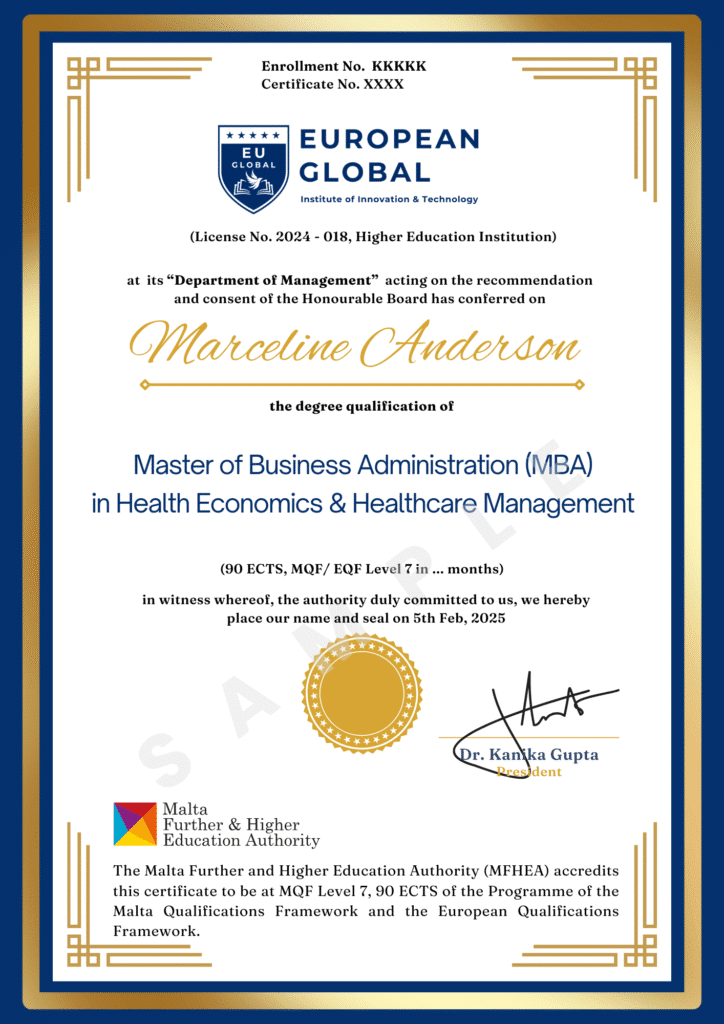
Sample Certificate
COURSE CONTENT (CORE MODULES 30 ECTS)
Module 1: Management and Organizational Dynamics (3 ECTS, 75 Hours)
This module delves into the core principles of management and the intricate nature of organizational behaviour within modern business settings. It highlights how effective management influences organizational culture, performance, and overall success. By integrating key theories with practical insights, students will develop the ability to analyze, interpret, and manage the various internal and external factors that drive organizational change and dynamics.
Module 2: Managing Financial Resources and Performance (3 ECTS, 75 Hours)
This module explores both the theoretical foundations and contemporary practices of financial management, including financial reporting, cost and managerial accounting, valuation, and performance analysis across diverse organizational contexts. Students will learn to apply accounting principles, tools, and frameworks to enhance decision-making and leadership effectiveness. Emphasis is placed on interpreting and utilizing financial information to assess performance and support strategic objectives in private, public, and non-profit organizations.
The module also promotes professional development through interactive learning, requiring students to engage with a range of financial data, case studies, and analytical activities. Participants will gain practical experience in preparing and analyzing financial statements, applying financial ratios and standards, and conducting forecasting, valuation, and risk assessments to support sound financial decision-making.
Module 3: Strategic and Digital Marketing (3 ECTS, 75 Hours)
In an increasingly digitalized business environment, organizations must continuously evolve their marketing approaches to connect with audiences and sustain growth. This module provides students with a strategic understanding of digital marketing principles and their application in achieving competitive advantage. It covers a wide spectrum of digital marketing tools, strategies, and frameworks, emphasizing how technology and innovation shape modern marketing practices.
Students will learn how to align digital marketing initiatives with broader business objectives and use data analytics to inform strategy, optimize performance, and strengthen customer relationships. Through practical case studies and strategic analysis, the module fosters the ability to design, implement, and manage effective digital marketing campaigns that drive measurable results and support long-term organizational success.
Module 4: Project and Operations Management (3 ECTS, 75 Hours)
This module provides an in-depth understanding of how organizations plan, manage, and optimize projects and operational processes to achieve strategic success. It equips students with the essential principles, frameworks, and analytical tools required to effectively oversee projects and operations across different business sectors.
Key areas of study include project management methodologies, operational strategy, process improvement, quality assurance, and supply chain management. Students will develop the ability to design, implement, and monitor projects to ensure timely delivery, cost efficiency, and alignment with organizational goals. The module also emphasizes the integration of operations management with business strategy, focusing on enhancing productivity, maintaining quality standards, and driving customer satisfaction through effective process and resource management.
Module 5: Financial Markets and Valuation (3 ECTS, 75 Hours)
This module provides students with a comprehensive understanding of key financial concepts and challenges faced by organizations at the strategic level. It prepares participants to effectively collaborate with finance and accounting professionals and to make informed financial decisions within diverse business contexts.
Students will explore the fundamentals of financial analysis, corporate finance, and valuation techniques, gaining insight into how financial markets operate and influence organizational strategy. The module addresses real-world financial issues relevant to both private and public sectors, with a strong emphasis on global financial dynamics. By the end of the module, students will be able to apply financial theories and analytical tools to assess value, manage risk, and solve complex financial problems in a professional environment.
Module 6: Strategic Decision Making: Dealing with Business Complexity (3 ECTS, 75 Hours)
This module explores how organizations formulate and implement strategies in complex and dynamic business environments. It emphasizes the importance of consistency, commitment, and adaptability in strategic decision-making. Students will learn to analyze environmental challenges, identify competitive advantages, and leverage organizational resources and capabilities to achieve sustainable success.
Through real-world case studies and practical examples, the module deepens students’ understanding of how strategic choices shape organizational performance and long-term positioning. It also encourages critical reflection on the dynamics of strategy, enabling students to develop the analytical and decision-making skills necessary to manage uncertainty, competition, and change effectively within diverse business contexts.
Module 7: Economics for Decision-Making (3 ECTS, 75 Hours)
This module provides students with a solid foundation in economic theory and its application to managerial decision-making. It combines key concepts from microeconomics and macroeconomics to help students understand market behaviour, policy impacts, and the broader economic forces influencing business performance.
Emphasis is placed on developing practical analytical skills that enable students to interpret economic data, evaluate market conditions, and make sound strategic choices. By applying economic reasoning to real-world business situations, students will learn how to assess risks, anticipate trends, and design effective strategies that promote organizational growth and competitiveness in an increasingly globalized economy.
Module 8: Ethical Leadership and Governance (3 ECTS, 75 Hours)
This module offers a comprehensive examination of ethical leadership principles and governance systems within modern organizational contexts. It explores the ethical responsibilities of leaders and the role of governance structures in promoting accountability, transparency, and responsible decision-making.
Students will develop the skills and mindset needed to navigate ethical dilemmas, foster integrity, and uphold professional standards in complex business environments. Through theoretical frameworks, real-world case studies, and applied learning, the module equips participants to lead ethically, implement effective governance practices, and create organizational cultures grounded in trust and ethical excellence.
Module 9: Corporate Sustainability and Leadership (3 ECTS, 75 Hours)
This module explores the principles and practices of corporate sustainability and their alignment with effective leadership in modern organizations. It focuses on how leaders can integrate environmental, social, and economic priorities into strategic decision-making to promote long-term organizational success and societal well-being.
Students will examine key sustainability frameworks, leadership models, and global case studies to understand how ethical and visionary leadership drives sustainable transformation. Emphasis is placed on addressing pressing global issues such as climate change, resource management, and social responsibility, while fostering a culture of innovation and accountability that supports sustainable growth and corporate resilience.
Module 10: Business Communication for Competitive Advantage (3 ECTS, 75 Hours)
In today’s fast-paced and interconnected business world, strong communication skills are essential for both individual and organizational success. This module focuses on developing the advanced communication and interpersonal skills required for effective leadership, teamwork, and strategic influence. It blends contemporary communication theories with real-world case studies to provide a practical and applied learning experience.
Students will refine their ability to communicate clearly and persuasively across diverse professional contexts, including written, verbal, and digital formats. The module also addresses cross-cultural communication and the strategic use of modern communication technologies. By the end of the course, participants will be able to convey ideas with confidence, adapt their communication styles to different audiences, and leverage communication as a tool for achieving competitive and professional excellence.
COURSE CONTENT (PATHWAY MODULES 30 ECTS)
Module Overview: Health Economics and Decision-Making
This module provides students with an advanced understanding of the theoretical foundations and practical applications of health economics in supporting efficient and equitable healthcare decision-making. It explores how economic principles and analytical tools can be applied to improve the allocation of healthcare resources, ensuring optimal outcomes for both patients and healthcare systems.
Students will gain a comprehensive overview of health economic evaluation methods, including cost-effectiveness, cost-utility, and cost-benefit analyses. The module also introduces techniques for modeling healthcare decisions, evaluating policy impacts, and interpreting evidence to guide resource allocation.
By engaging with case studies and real-world applications, learners will develop the ability to critically assess healthcare interventions, balance efficiency with equity, and contribute to informed policy and management decisions.
Upon completion, students will have the knowledge and analytical skills necessary to conduct basic health economic evaluations and explore advanced approaches to assessing value for money in healthcare. The module serves as a foundation for strategic leadership in health economics, healthcare management, and policy design.
This MBA module aims to provide the knowledge of national and international healthcare policies to the learners. Each country has a different political, economic, cultural and legal environment and these components affect the policies. The learners will develop understanding how political, social and cultural issues help in determining the healthcare policies. They will also develop understanding on the difference in strategy as per national and international context. This module will be a part of the elective course.
Module Overview: Change Management in Health and Social Care
This elective module provides an in-depth understanding of change management theories and their practical application within the healthcare and social care sectors. It is designed to equip students with the strategic and analytical tools necessary to lead and manage transformation in complex, dynamic, and people-centered environments.
Students will explore key models of organizational change, understanding how these frameworks can be effectively implemented to address evolving challenges in healthcare delivery, policy, and service design. The module emphasizes the role of leadership in driving sustainable change, fostering innovation, and empowering service users and stakeholders throughout the transition process.
Through case studies and applied learning, learners will critically evaluate global perspectives on health and social care reform, analyzing how change management strategies vary across different organizational and cultural contexts.
By the end of this module, students will be able to:
Apply relevant change management theories to complex health and social care settings.
Assess the impact of policy, leadership, and stakeholder engagement on successful change implementation.
Design adaptive strategies that respond to emerging challenges and promote service improvement.
This module encourages reflective and evidence-based practice, preparing graduates to lead meaningful transformation in healthcare and social care organizations worldwide.
Module Overview: Data Science and Analytics in Healthcare
This module provides a comprehensive understanding of how data science and advanced analytics are transforming decision-making and innovation within the healthcare industry. It focuses on the use of scalable machine learning, data mining, and analytical systems to manage, interpret, and derive actionable insights from large, complex, and heterogeneous healthcare datasets.
Students will explore the challenges and opportunities presented by the rapid growth in healthcare data volume, velocity, and variety, examining how data-driven strategies can improve clinical outcomes, optimize resource allocation, and enhance patient care. The module covers the fundamentals of data analytics, predictive modeling, and healthcare informatics, alongside discussions of ethical considerations, data governance, and privacy regulations in healthcare data management.
Through case studies and applied exercises, learners will gain hands-on experience in interpreting real-world healthcare data and using analytical tools to support evidence-based decision-making. By the end of the module, students will understand how to design and implement data-driven solutions that support efficient, effective, and equitable healthcare delivery.
Module Overview: Information and Communication Technologies in Healthcare
This module explores the transformative role of information and communication technologies (ICT) in reshaping the landscape of modern healthcare. It provides students with a comprehensive understanding of how digital innovations are revolutionizing the way healthcare is delivered, managed, researched, and taught across global health systems.
Learners will examine a wide range of technologies driving this transformation, including electronic health records (EHRs), health information systems, telemedicine, mobile health (mHealth), remote patient monitoring, digital imaging, virtual and augmented reality, artificial intelligence (AI), robotics, and genomics.
The module emphasizes how these technologies contribute to improving clinical efficiency, patient outcomes, and data-driven decision-making, while also addressing the ethical, legal, and operational challenges of digital health adoption.
By engaging with real-world case studies and applied learning activities, students will gain the ability to critically assess and implement ICT-driven strategies that enhance healthcare accessibility, quality, and innovation. The course also prepares learners to lead digital transformation initiatives in healthcare organizations, bridging the gap between technology and patient-centered care.
COURSE CONTENT (RESEARCH & INNOVATION MODULES 30 ECTS)
Module Overview: Innovation and Design Thinking in Entrepreneurship
This module equips MBA students with the strategic knowledge and practical skills required to drive innovation and apply design thinking methodologies within entrepreneurial and organizational contexts. It emphasizes how creativity, experimentation, and human-centered design can be harnessed to generate innovative solutions and sustainable business value.
Students will explore key concepts in innovation management, including the ideation process, product and service development, commercialization strategies, and the management of innovation ecosystems. The module also focuses on applying design thinking principles—such as empathy, ideation, prototyping, and testing—to address complex business and societal challenges.
Through a combination of theory, case studies, and experiential learning, students will learn to identify opportunities, challenge assumptions, and transform ideas into viable ventures. The course fosters an entrepreneurial mindset that balances creativity with analytical rigor, preparing graduates to lead innovation-driven organizations in dynamic global markets.
By the end of the module, learners will be able to design, evaluate, and implement innovation strategies that enhance competitive advantage and contribute to long-term organizational success.
Module Overview: Research Methods for Business and Management
This module provides MBA students with a comprehensive foundation in the principles, methodologies, and practical applications of business research. It is designed to develop the analytical and methodological skills necessary to conduct rigorous, evidence-based research that informs strategic decision-making and organizational improvement.
Students will explore the full research process—from formulating research questions and reviewing existing literature to designing research frameworks, selecting data collection methods, and applying appropriate analysis techniques. The module covers both qualitative and quantitative research approaches, ensuring that students are able to design and evaluate studies across diverse business contexts.
In addition, the module emphasizes ethical research practices, transparency, and data integrity, preparing students to navigate the ethical challenges of contemporary research environments. Learners will also gain practical experience in developing research proposals, interpreting data, and presenting findings in a clear, professional, and academically sound manner.
By the end of this module, students will be equipped with the skills to undertake independent research projects, including their MBA capstone or dissertation, and to apply research insights effectively within professional and organizational settings.
Module Overview: Capstone Consulting Project
The Capstone Consulting Project serves as the culminating experience of the MBA program, enabling students to synthesize, apply, and demonstrate the knowledge and competencies developed throughout their studies. This module provides a practical platform for students to engage with real-world business challenges—either individually or in teams—by collaborating with industry partners, organizations, or entrepreneurial ventures.
Students will undertake a comprehensive consulting assignment, involving the diagnosis of complex business problems, the formulation of strategic recommendations, and the presentation of actionable solutions. Emphasis is placed on evidence-based decision-making, critical thinking, leadership, collaboration, and professional communication.
For students enrolled in an on-campus mode, the Capstone Project may be completed alongside an internship, allowing for additional practical exposure and the application of learning in professional environments.
Boost Your Portfolio with Evidence-Based Learning
EU Global’s unique Andragogy of Evidence-Based Management empowers learners to integrate research, practice, and reflection to achieve continuous professional growth.
As part of this capstone experience, students benefit from:
Research Residency – Engage in applied research within a business context.
Entrepreneurship Residency – Explore innovation and venture creation opportunities.
Professional Coaching – Receive guidance on leadership and career development.
Academic Coaching – Support for project structure, research design, and analysis.
1:1 Project Mentorship – Personalized guidance from experienced faculty and industry mentors.
Through this immersive experience, students not only consolidate their MBA learning but also build a professional portfolio that evidences their strategic, analytical, and leadership capabilities, preparing them for senior management and consulting roles across industries.
Career Services Beyond Classroom
1
Coaching and Mentoring
Receive one-on-one guidance from career advisors who will help you define your career goals, identify growth opportunities, and develop a clear roadmap for success in Strategic Digital Marketing
2
CV Review and LinkedIn Optimization
Our career experts will review and optimize your CV and LinkedIn profile to showcase your skills, projects, and achievements, increasing your visibility to recruiters and employers.
3
Career Acceleration workshops & Webinars
Participate in exclusive workshops and industry-led webinars focused on interview preparation, personal branding, networking, job search strategies, and emerging industry trends.
4
Internship & fulltime Job Placements
Gain access to internship and employment opportunities through our employer network, with ongoing support throughout your application and placement journey.
5
Module Specific Coaching & Mentoring
Receive personalized academic support throughout your programme, with dedicated coaching sessions to help you master each module, overcome challenges, and successfully complete practical projects and assessments.
Certification, Accreditation and Recognition





Frequently Asked Questions
What is an MBA in Health Economics and Healthcare Management?
The MBA in Health Economics and Healthcare Management is designed for professionals seeking advanced knowledge in healthcare leadership, health policy, healthcare finance, and strategic management within healthcare organizations.
Is the MBA in Health Economics and Healthcare Management globally recognized?
Yes. The program awards a globally recognized qualification aligned with international academic standards, supporting career growth across healthcare systems worldwide.
Who should enroll in this MBA program?
This program is ideal for healthcare professionals, hospital administrators, public health practitioners, medical managers, healthcare consultants, and professionals seeking leadership roles in healthcare organizations.
What will I learn in this MBA program?
Students develop expertise in healthcare economics, healthcare policy, healthcare finance, strategic management, healthcare operations, leadership, and healthcare quality improvement.
How does health economics contribute to healthcare management?
Health economics helps healthcare leaders make informed decisions about resource allocation, healthcare funding, cost-effectiveness, policy development, and improving patient outcomes.
What career opportunities are available after graduation?
Graduates can pursue careers as Healthcare Administrators, Hospital Managers, Health Policy Advisors, Healthcare Consultants, Public Health Managers, Healthcare Operations Managers, and Healthcare Executives.
Can working professionals study this MBA program?
Yes. The program offers flexible learning options that allow professionals to continue working while advancing their qualifications.
Why choose this MBA in Health Economics and Healthcare Management?
This program combines healthcare expertise, business leadership, international recognition, flexible learning, and practical management skills needed to succeed in today’s evolving healthcare sector.
Does the program cover healthcare policy and healthcare finance?
Yes. Students gain practical knowledge in healthcare financing, policy analysis, healthcare systems management, budgeting, and strategic healthcare planning.