Early bird scholarship up to 30%
⚠ Alert: Offer available till 28th of November 2026
Features of MBA in International Business

Learning Formula
Online/On Campus

Intakes
April/October

Language
English
Get to know more about the MBA in International Business
MBA in International Business with European Global Institute of Innovation
and Technology
Program Details
The MBA in International Business in Malta is built to turn professionals into globally minded business leaders. It goes well beyond standard business management; this is an EQF (European Qualifications Framework) Level 7 European Master’s degree centred on global strategy, cross-border trade, and international market operations.
The program runs online & On Campus, so you can earn a respected European degree while still leading in your organisation, wherever you’re based, including Nigeria. You get the same curriculum and global accreditation as on-campus programs in Europe, minus the expense of travel or relocation.
Key Academic Facts
- Credit Weight: 90 ECTS (European Credit Transfer and Accumulation System)
- Academic Level: Level 7 Master’s Degree (European Qualifications Framework)
- Double Certificate: Academic Degree awarded by European Global Institute of Innovation and Technology, Malta and a professional Certificate from Docenti Global Business School
- Duration: 12 to 18 months
- Structure: Core MBA modules, international business specialisation, and a final research project
- Accreditation: Accredited by the Malta Further and Higher Education Authority (MFHEA), evaluated by WES, and recognised internationally
- Special Scholarship Discount up to 30% off Eligible tuitions fee
- Tuition: ₦4,500,000.00
Program Journey
From Pre-Master to Graduation
How students progress through the MSc – from the Pre-Master's to the classes and coursework, capstone defense and finally the certificate issuance
1
2
3
4
1
Pre-Master Courses (BLEP)
- Data Analysis for Managers
- AI for Business and innovation
- AI for Researchers
- Critical and Reflective Practice
- Online Business Education
- Academic Coaching
- Language Classes
- Webinars and Workshops
2
Didactic Activities
- Live proficiency sessions with industry experts
- Capstone Grouping
- Self study on recorded sessions and class materials
- Assessments and project submissions
- Townhall Meetings with program coordinator/Director
- Company Visits
- Study tours
3
Capstone project
- Project Development
- Program Director supervision and reviews
- Mock defense and defense preparation
- Capstone Project defense with colleagues
4
Graduation and Certification
- Final Transcript and result issued
- Graduation Ceremony (Malta and Lagos)
- Master's Certificate issued
Explore the Programme
Tap any Button below to explore our Programme Guide.
- Why Choose Us?
- Programme Benefits
- Learning Outcomes
- Engaging Program Content
- Learning Support
- Program Structure
- Accreditations of the EU Global to the program
- Eligibility and Application Process
- Program Awarding Institutions and Title
- Program Completion
- Career Pathways
- Faculty
- Program Completion
Why International Business with European Global Institute of Innovation and Technology?
- From Operator to Strategist: Move your career from day-to-day business operations to becoming a key strategic voice in global expansion decisions.
- Global Credentials, Local Currency: Earn a degree accredited in the EU while paying in Naira. You save significantly on foreign exchange costs and living expenses by choosing our distance-learning model.
- Work Integrated Learning: Our case studies centre on real global business challenges, so you can apply international business practices directly to your current role in a Nigerian or multinational company.
- Elite Global Network: Connect with a diverse cohort of business leaders and executives from around the world, growing your professional reach well beyond local borders.
Research-Based Capstone Project & Quality Supervision (ISO9001:2015)
The 90-credit hour program is built around real case studies and established global business frameworks, helping you move from instinct-driven choices to strategies backed by solid market and economic data.
- Personalised Supervision: You’ll work closely with a doctoral-level supervisor who guides you in designing and carrying out a research project focused on a real international business challenge.
- Research Rigour: You’ll be supported through the process of gathering and analysing market or organisational data, ensuring your final thesis meets recognised international academic and professional standards.
- The Mark of Excellence: Completing this research demonstrates your ability to manage complex global business challenges, positioning you as a strong candidate for international firms.
Core Research & Specialisation Areas
Students can focus their research on some of the most pressing issues in global business today:
- Digital Transformation & Global Trade: Navigating the shift toward AI-driven operations and digital-first international trade.
- Global Market Entry & Expansion: Strategies for entering and scaling in new markets across different regions and economies.
- Cross-Border Strategy & Change Management: Managing mergers, acquisitions, and organisational shifts in unpredictable global markets.
- International Finance & Risk Management: Designing data-led financial strategies that manage risk and drive performance across borders.
Programme Benefits
- Recognized European degree (Double Certification)
- 12 Months Duration
- Early Bird scholarship is available(up to 30%)
- Assess innovation and entrepreneurship opportunities in the world of Media & Entertainment
- Establish & Accelerate your career in Media & Entertainment and internship opportunities in multinational corporations.
- Whether your passion lies in film,music,digital media or entertainment business, this program equips you with the strategic insight and practical skills neeeded to thrive in a faste-paced ever-changing landscape. Embark on a transformative journey and position yourself at the forefront of the global media entertainment industry.
- international Exposure – Study tours in Rome, China, Denmark, India, Doha, Singapore, and Rwanda.
- Start your program in Lagos, Nigeria and attend a graduation in Rome, Italy.
- Job placement opportunities
- Long life learning through alumni realtions.
- Networking opportunities with Captains of industries, Business tycoons, Faculty members, and Fellow executive students.
After the programme, learners will be able to:
Professional Application (PA)
- PA1: Critically assess complex and uncertain business situations, drawing on multiple disciplines to make sound strategic decisions even when information is incomplete.
- PA2: Respond effectively to fast-changing business environments, particularly within international business, by setting clear criteria, developing innovative solutions, applying adaptable strategies, and assessing outcomes under uncertain conditions.
- PA3: Show strong leadership and team-building abilities in multicultural settings, managing conflict and engaging stakeholders effectively, especially in international business contexts.
- PA4: Take ownership of continuous learning and professional growth through reflection, using research-based insights to address emerging challenges in international business.
- PA5: Set strategic benchmarks, guide teams, track performance, and drive ongoing improvement across varied business settings, in line with international business best practices.
- PA6: Work through ethical dilemmas involving competing stakeholder interests and cross-border complexities, while maintaining strong ethical standards and corporate governance in international business.
- PA7: Carry out thorough business research, critically reviewing existing literature, applying advanced research methods, and contributing meaningful findings to the field of international business.
Knowledge Outcomes (PB)
- PB1: Critically assess how contextual factors (legal, ethical, economic, environmental, social, technological, international, and governance-related) influence organisations and management functions.
- PB2: Combine knowledge from finance, technology, ethics, and data analytics to support well-rounded financial decision-making within international business and organisational success.
- PB3: Critically evaluate effective international business strategies, drawing on technology, ethics, and data analytics to improve organisational performance.
- PB4: Develop and apply adaptable business policies and strategies within international business or general management, using current theoretical and practical knowledge.
- PB5: Critically examine and improve production and marketing processes using advanced problem-solving approaches, with a focus on decision-making in international business.
- PB6: Build and adjust business frameworks to anticipate shifts in markets, organisations, and industries, particularly within an international business context.
- PB7: Critically review academic literature, apply research methods, and develop new frameworks at the forefront of international business and management studies.
- PB8: Assess and apply ethical leadership, corporate governance, and sustainability practices to support responsible business conduct in international business.
- PB9: Draw on specialised international business knowledge to address specific challenges and opportunities within the field.
Note: PB1 to PB7 are required for diploma exit; PB1 to PB9 are required for the full Master’s degree (see exit awards for details).
Skills Outcomes (PC)
- PC1: Critically assess and bring together complex, multidisciplinary data to produce practical insights, taking social, cultural, and environmental impacts into account within international business.
- PC2: Use advanced quantitative and qualitative research methods to examine business challenges, producing original, evidence-based conclusions in changing international business contexts.
- PC3: Communicate research findings clearly and effectively, showing leadership in stakeholder engagement, negotiation, and decision-making across a range of settings.
- PC4: Pursue innovation, adaptability, and strategic thinking to support professional growth, continuous learning, and competitive advantage.
- PC5: Lead high-performing teams through collaboration, critical thinking, and transformative decision-making in complex international business environments.
Engaging Programme Content:
Video Lectures:
Pre-recorded lectures you can watch at your convenience.
Interactive Modules:
Multimedia content with quizzes, exercises, and simulations to reinforce learning.
Live Webinars:
Real-time sessions with faculty for lectures, Q&A, and discussions (often recorded for later viewing).
Guest Speakers:
Industry experts sharing insights and real-world perspectives.
We Support Learning
Collaborative Learning:
Online discussions, group projects, and peer feedback are common to foster interaction and knowledge sharing.
Active Learning:
You will be actively involved in the learning process through discussions, problem-solving, and applying concepts to real-world cases.
Modern Technology-Enhanced:
Online platforms provide access to resources, communication tools, and learning materials 24/7.
Global Community:
Interact with classmates from diverse backgrounds and locations, broadening your perspectives.
Programme Details
- Accelerated – 1 Year
Full-time – 18 Months
Part-time – upto 3 years - Start Date:
1st working day of every month - Application Due Date:
Ongoing - ECTS Credits:
90 ECTS Credits - Language:
English - EQF Level:
Masters Degree, Level 7 - Weekly Hours:
15-40 Hours per week - Teaching:
Asynchronous, Live MasterCamps - Tuition: 4, 000, 000.00
Learning Method
Asynchronous/Blended Learning: Delivered through the E-Campus of European Institute of Innovation and technology and Docenti LMS (Learning Management System) with live classes conducted via virtual conferencing platforms.
Coursework-Based Curriculum
- Assessment: Assignment, Capstone Project
- Collaborative Learning: Opportunity to connect and work with peers worldwide through webinars.
The content is specially procured by highly experienced professors and industry experts’ team for you to learn 24X7.
This programme can be studied anywhere in the world and earn globally reputed MQF/EQF accredited degree.
Eligibility
The following scanned copies of the documents are required to be provided to be admitted for the program.
- Biopage of your valid passport, National ID card or Driving License.
- Bachelor’s academic transcript and degree certificate in any discipline OR equivalent completion of Level 6 qualification with at least 180 ECTS, HND or a four-year undergraduate degree.
- The applicant must have studied Mathematics at least MQF level 5 (Undergraduate Diploma/Certificate or OND in statistics or done our Skill Development Program in Data Science Diploma) or equivalent knowledge of mathematics (for instance, linear algebra, calculus).
- 200-300 words Statement of Purpose/Motivational Letter.
- Scan of passport size photograph.
World Educational Services (WES)

European Global Institute of Innovation & Technology (EU Global) Malta appears in the list of World Educational Services (WES). EU Global in WES list facilitates credential evaluation for further studies and employment in countries such as the United States and Canada.
Electronic Transcript Exchange and Certificate Verification System

The Electronic Transcript Exchange and Certificate Verification System for Nigeria has evaluated Maltese master’s degrees and deemed them equivalent to Nigerian master’s degrees. This confirms that the program meets Nigerian academic standards for master’s level education.
QAHE International Association

Quality Assurance in pre-tertiary and higher education (QAHE) is an organization that focuses on ensuring high standards of quality in education at both pre-tertiary and higher education levels. This organization is responsible for developing and implementing quality assurance mechanisms to enhance the overall educational experience for students.
Institute Of Analytics
The Institute of Analytics (IoA), UK accredits the Docenti Global Business School’s Data Science Diploma course. with 𝐃𝐨𝐜𝐞𝐧𝐭𝐢 𝐁𝐮𝐬𝐢𝐧𝐞𝐬𝐬 𝐒𝐜𝐡𝐨𝐨𝐥’𝐬 𝐃𝐢𝐩𝐥𝐨𝐦𝐚 𝐢𝐧 𝐃𝐚𝐭𝐚 𝐒𝐜𝐢𝐞𝐧𝐜𝐞, 𝐚𝐜𝐜𝐫𝐞𝐝𝐢𝐭𝐞𝐝 𝐛𝐲 𝐭𝐡𝐞 𝐈𝐧𝐬𝐭𝐢𝐭𝐮𝐭𝐞 𝐨𝐟 𝐀𝐧𝐚𝐥𝐲𝐭𝐢𝐜𝐬 (𝐈𝐨𝐀), the globally recognized professional body for analytics and data science. IoA accreditation fast-tracks your eligibility for full IoA membership, connecting you with the world’s leading analytics professionals and exclusive learning opportunities. Students of other programs like the Power MBA and Corporate Foundation Program also benefits from Affiliate Membership.
International Skill Development Corporation
Docenti Global Business School partners with International Skill Development Corporation (ISDC)to offer both undergraduate and post-graduate academic and skilled-based progression degrees to different UK universities. Graduates of this program under the DGBS Power MBA and undergraduate degrees can benefit from progression opportunities, including credit transfer towards an MBA or equivalent postgraduate qualifications with partner universities in the UK. These undergraduate and post-graduate programmes are accredited by the Scottish Qualifications Authority (SQA), Scotland, United Kingdom. The Scottish Qualifications Authority is an executive non-departmental public body of the Scottish Government responsible for awarding qualifications and accrediting other awarding bodies.
ISO
Docenti Global Business School has received ISO 9001:2015 certification for its academic supervisory system for Master’s and Doctoral students. Announced in Lagos on 17 September 2025, the recognition affirms the institution’s commitment to international quality standards in postgraduate education. Covering mentorship, progress monitoring, and academic support from coursework to final defence, the certification reinforces Docenti’s dedication to excellence in teaching, research, and academic delivery.
Admission Requirements
To complete your application for the MBA in Strategic Digital Marketing, applicants are required to submit clear scanned copies of the following documents:
Proof of Identity
Biographical page of a valid passport, National ID card, or Driver’s License.
Academic Qualifications
Bachelor’s degree certificate and academic transcript in any discipline,
OR
An equivalent Level 6 qualification (minimum of 180 ECTS), HND, or a four-year undergraduate degree.
Statement of Purpose / Motivational Letter
A 200–300 word personal statement outlining your career goals, motivation for pursuing the MBA, and how the program aligns with your professional aspirations.
Passport Photograph
A scanned copy of a recent passport-sized photograph (clear and in color).
These documents ensure that each applicant meets the academic and professional criteria for admission into this globally recognized MBA in Strategic Digital Marketing program.
Awards/Qualifications
Our strategic accreditation allows every learner to earn ECTS credits for every module they study. This allows students to take deferrals, exits and re-join studies and use same ECTS credits for an advanced entry into the programme.
- Award: MBA in Strategic Human Resource Management from European Global Institute of Technology and Innovation, Malta.
- Certificate of Completion for LifeLong Learning in MBA in Strategic Human Resource Management from Docenti Global Business School.
Awarding Body:
- European Global Institute of Technology and Innovation.
- Each module is expected to be completed in 5 weeks when studied full-time, and 8-10 weeks when studied part-time. The full-time and part-time modes will follow the same structure, the only difference will be related to weekly learning hours spent as stated in the duration in the above section.
- MBA in Strategic Human Resource Management/ 90 ECTS: Students have to complete all three semesters. The 3 Semester can also be compressed in 12 months.
Capstone Consulting Project
The Capstone Consulting Project serves as the final and most integrative component of the MBA program, allowing students to apply the full range of knowledge and competencies gained throughout their studies. It bridges academic learning with real-world application by engaging participants in live consulting projects in collaboration with industry partners.
Students may work individually or in teams to analyze real business challenges, design data-driven strategies, and develop practical, results-oriented solutions for client organizations. The experience sharpens their ability to think critically, solve complex problems, and communicate professionally within a business context.
This project not only demonstrates each learner’s capacity to create measurable impact but also enhances their leadership, collaboration, and consulting expertise-skills that are essential for senior management and strategic roles across industries.
Relationship to Occupation/s
Learners who successfully achieve the outcomes of this programme can pursue the following career paths:
Career Path – Job Description
- International Business Director / Head of Global Operations – Oversee market expansion, operational strategy, and cross-border business initiatives.
- Chief Executive Officer (CEO) / Chief Operating Officer (COO) – Lead overall business strategy, growth planning, and organisational development on a global scale.
- Global Business Development Manager – Manage international partnerships, market entry strategies, and cross-border business relationships.
- International Trade Consultant – Advise organisations on trade policy, export strategy, and regulatory compliance across markets.
- Business Strategy Consultant – Drive strategic planning, market analysis, and performance optimisation for organisations operating globally.
- International Finance Manager – Oversee financial planning, risk management, and investment strategy across international markets.
- Business School Professor / Lecturer – Teach and conduct research in international business, global strategy, or management.
- Global Market Research Analyst – Conduct market research, competitive analysis, and industry trend forecasting across international markets.
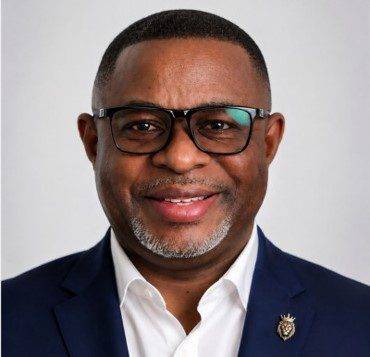
Hon. Remy Chukwunyere
Regional Director | Head of Partnerships | International Development Executive | Ecosystem Builder | Keynote Speaker | AI Strategist | 23+ Years of Global Impact | Member – Sweden Alumni Network

Dr. Charles Ugwu
Managing Partner, El-loman International Ltd

Dr. Dennis Edogun
The Risk Dad | Helping Business Owners Reduce Owner-Dependency Risk | Building More Resilient, Transferable Businesses | Business Resilience Checkups

Dr. Omotola Elatuyi
Founder Chief Executive Awesome Empowerment Foundation | Marketing and Innovations Director Pladis Global

Mrs. Foluke Michael
Founder, The Foluke Michael Studio | Building Creative Economy For Sustainable Development | Author, From Image to Institution | Museums • AI • Cultural Diplomacy • Africa ↔ Europe .
Capstone Consulting Project
The Capstone Consulting Project is the final milestone of your MBA in International Business. This practical, hands-on project lets you apply advanced business strategies to real organisational challenges by working alongside industry partners to solve pressing issues in global business operations.
Project Overview:
Work in teams to tackle real-world international business challenges faced by corporate partners.
Develop actionable solutions for:
- Market entry and expansion strategies
- Cross-border organisational development and change management
- International trade and supply chain challenges
- Global performance and operations management
- Business analytics and data-driven decision-making
Learning Outcomes:
Upon successful completion of the Capstone Consulting Project, graduates will have developed the following key competencies.
- Strategic Problem-Solving in International Business
- Diagnose complex organisational and market challenges through systematic analysis.
- Develop innovative solutions that drive measurable business results across borders.
- Evaluate multiple approaches to select the most effective international business strategies.
- Advanced Project Leadership in Global Business
- Apply agile methodologies to execute international business initiatives efficiently.
- Lead diverse, multicultural project teams to deliver impactful business solutions.
- Manage every stage of a project, from initial concept through to final evaluation.
- Executive Communication & Influence
- Present compelling business cases to senior leadership and stakeholders.
- Translate complex business concepts into clear, strategic language.
- Influence organisational decision-making through data-driven insights.
- Change Management Expertise
- Design thorough change management frameworks for international business transformations.
- Measure and report on the return on investment of strategic business initiatives.
- Address resistance to change within organisations operating across borders.
- Global Business Leadership
- Develop culturally aware business solutions suited to multinational organisations.
- Navigate complex international trade regulations and compliance requirements.
- Implement global business strategies that remain adaptable to local markets.
Total Number of ECTS for this Module/Unit
- 18 ECTS
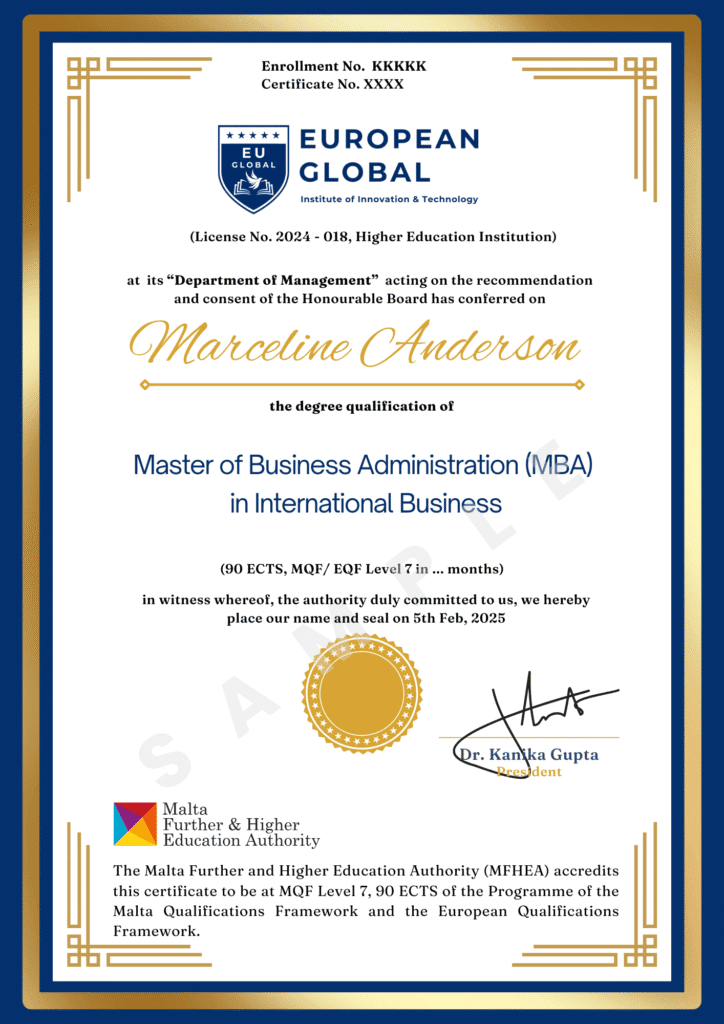
Sample Certificate
COURSE CONTENT (CORE MODULES 30 ECTS)
Module 1: Management and Organizational Dynamics (3 ECTS, 75 Hours)
This module delves into the core principles of management and the intricate nature of organizational behaviour within modern business settings. It highlights how effective management influences organizational culture, performance, and overall success. By integrating key theories with practical insights, students will develop the ability to analyze, interpret, and manage the various internal and external factors that drive organizational change and dynamics.
Module 2: Managing Financial Resources and Performance (3 ECTS, 75 Hours)
This module explores both the theoretical foundations and contemporary practices of financial management, including financial reporting, cost and managerial accounting, valuation, and performance analysis across diverse organizational contexts. Students will learn to apply accounting principles, tools, and frameworks to enhance decision-making and leadership effectiveness. Emphasis is placed on interpreting and utilizing financial information to assess performance and support strategic objectives in private, public, and non-profit organizations.
The module also promotes professional development through interactive learning, requiring students to engage with a range of financial data, case studies, and analytical activities. Participants will gain practical experience in preparing and analyzing financial statements, applying financial ratios and standards, and conducting forecasting, valuation, and risk assessments to support sound financial decision-making.
Module 3: Strategic and Digital Marketing (3 ECTS, 75 Hours)
In an increasingly digitalized business environment, organizations must continuously evolve their marketing approaches to connect with audiences and sustain growth. This module provides students with a strategic understanding of digital marketing principles and their application in achieving competitive advantage. It covers a wide spectrum of digital marketing tools, strategies, and frameworks, emphasizing how technology and innovation shape modern marketing practices.
Students will learn how to align digital marketing initiatives with broader business objectives and use data analytics to inform strategy, optimize performance, and strengthen customer relationships. Through practical case studies and strategic analysis, the module fosters the ability to design, implement, and manage effective digital marketing campaigns that drive measurable results and support long-term organizational success.
Module 4: Project and Operations Management (3 ECTS, 75 Hours)
This module provides an in-depth understanding of how organizations plan, manage, and optimize projects and operational processes to achieve strategic success. It equips students with the essential principles, frameworks, and analytical tools required to effectively oversee projects and operations across different business sectors.
Key areas of study include project management methodologies, operational strategy, process improvement, quality assurance, and supply chain management. Students will develop the ability to design, implement, and monitor projects to ensure timely delivery, cost efficiency, and alignment with organizational goals. The module also emphasizes the integration of operations management with business strategy, focusing on enhancing productivity, maintaining quality standards, and driving customer satisfaction through effective process and resource management.
Module 5: Financial Markets and Valuation (3 ECTS, 75 Hours)
This module provides students with a comprehensive understanding of key financial concepts and challenges faced by organizations at the strategic level. It prepares participants to effectively collaborate with finance and accounting professionals and to make informed financial decisions within diverse business contexts.
Students will explore the fundamentals of financial analysis, corporate finance, and valuation techniques, gaining insight into how financial markets operate and influence organizational strategy. The module addresses real-world financial issues relevant to both private and public sectors, with a strong emphasis on global financial dynamics. By the end of the module, students will be able to apply financial theories and analytical tools to assess value, manage risk, and solve complex financial problems in a professional environment.
Module 6: Strategic Decision Making: Dealing with Business Complexity (3 ECTS, 75 Hours)
This module explores how organizations formulate and implement strategies in complex and dynamic business environments. It emphasizes the importance of consistency, commitment, and adaptability in strategic decision-making. Students will learn to analyze environmental challenges, identify competitive advantages, and leverage organizational resources and capabilities to achieve sustainable success.
Through real-world case studies and practical examples, the module deepens students’ understanding of how strategic choices shape organizational performance and long-term positioning. It also encourages critical reflection on the dynamics of strategy, enabling students to develop the analytical and decision-making skills necessary to manage uncertainty, competition, and change effectively within diverse business contexts.
Module 7: Economics for Decision-Making (3 ECTS, 75 Hours)
This module provides students with a solid foundation in economic theory and its application to managerial decision-making. It combines key concepts from microeconomics and macroeconomics to help students understand market behaviour, policy impacts, and the broader economic forces influencing business performance.
Emphasis is placed on developing practical analytical skills that enable students to interpret economic data, evaluate market conditions, and make sound strategic choices. By applying economic reasoning to real-world business situations, students will learn how to assess risks, anticipate trends, and design effective strategies that promote organizational growth and competitiveness in an increasingly globalized economy.
Module 8: Ethical Leadership and Governance (3 ECTS, 75 Hours)
This module offers a comprehensive examination of ethical leadership principles and governance systems within modern organizational contexts. It explores the ethical responsibilities of leaders and the role of governance structures in promoting accountability, transparency, and responsible decision-making.
Students will develop the skills and mindset needed to navigate ethical dilemmas, foster integrity, and uphold professional standards in complex business environments. Through theoretical frameworks, real-world case studies, and applied learning, the module equips participants to lead ethically, implement effective governance practices, and create organizational cultures grounded in trust and ethical excellence.
Module 9: Corporate Sustainability and Leadership (3 ECTS, 75 Hours)
This module explores the principles and practices of corporate sustainability and their alignment with effective leadership in modern organizations. It focuses on how leaders can integrate environmental, social, and economic priorities into strategic decision-making to promote long-term organizational success and societal well-being.
Students will examine key sustainability frameworks, leadership models, and global case studies to understand how ethical and visionary leadership drives sustainable transformation. Emphasis is placed on addressing pressing global issues such as climate change, resource management, and social responsibility, while fostering a culture of innovation and accountability that supports sustainable growth and corporate resilience.
Module 10: Business Communication for Competitive Advantage (3 ECTS, 75 Hours)
In today’s fast-paced and interconnected business world, strong communication skills are essential for both individual and organizational success. This module focuses on developing the advanced communication and interpersonal skills required for effective leadership, teamwork, and strategic influence. It blends contemporary communication theories with real-world case studies to provide a practical and applied learning experience.
Students will refine their ability to communicate clearly and persuasively across diverse professional contexts, including written, verbal, and digital formats. The module also addresses cross-cultural communication and the strategic use of modern communication technologies. By the end of the course, participants will be able to convey ideas with confidence, adapt their communication styles to different audiences, and leverage communication as a tool for achieving competitive and professional excellence.
COURSE CONTENT (PATHWAY MODULES 30 ECTS)
Module 1: International Business Policy (6 ECTS)
The International Business Policy course forms a key part of the MBA program, aimed at giving students a solid grasp of today’s complex and fast-changing global business landscape. It looks at how business strategies are formed, put into practice, and assessed on an international scale, with particular attention to how policy influences the way global operations are run. Students will look closely at how political, economic, legal, and cultural forces affect multinational enterprises (MNEs), while building the skills to design strategies that boost competitiveness across different markets. Using case studies, class discussion, and hands-on exercises, students will develop the practical know-how to handle both the challenges and opportunities that come with doing business internationally.
Module 2: International Marketing (6 ECTS)
This MBA module gives learners the tools to design market entry strategies and build effective marketing plans for international markets. It covers the practices and approaches involved in marketing products and services on a global scale, while exposing students to a range of global business activities and how to assess international forces when shaping strategy. Along the way, students will pick up the knowledge and skills needed to craft strong international marketing strategies and handle the challenges that come up when putting them into action. The module also helps build a broader perspective on international marketing as a whole, including the ethical questions that come with operating across borders.
Module 3: International Finance (6 ECTS)
This module helps learners build a strong understanding of the international financial market and how to analyse it. It offers an in-depth look at financial management from a global perspective, helping students grasp the factors that drive financial stability, interconnectedness, and opportunity across both regional and global markets. Learners will explore areas such as financial risk, exchange rates, capital flows, and international investment, gaining the tools needed to work through the financial challenges and opportunities that arise in global markets. The module also builds a deeper understanding of cross-border investment and capital movement. Overall, the course aims to introduce and critically assess the key economic theories and models across these three core areas of international finance, and to apply these analytical tools to better understand real-world economic developments and policy issues in global markets.
Module 4: nternational Organisations & Strategy (6 ECTS)
This MBA unit is designed to give students insight into how international organisations function internally and the challenges they face day to day. It also looks at organisational strategy and strategic management within these organisations, helping learners understand how international organisations stay competitive in global markets. The course explores key theoretical and empirical perspectives on the role international organisations play in global politics, and how they shape international cooperation and conflict, economic relations, and the push for stronger environmental standards worldwide.
As businesses expand across borders, they run into new challenges on a regular basis. This module equips learners to assess global competitive dynamics, carry out industry analysis, and work on building strategic alliances.
Module 5: Global Business Management (6 ECTS)
This MBA module helps learners build a managerial perspective on global business. It covers the key principles and practices involved in managing a business within the global trade and investment environment, giving students a solid understanding of the strategic, operational, and managerial aspects of expanding into international markets, along with the challenges and opportunities that come with it. The module also takes a closer look at how global business is managed in practice, and how cultural, political, and economic factors shape the way businesses operate on the global stage.
COURSE CONTENT (RESEARCH & INNOVATION MODULES 30 ECTS)
Module 1: Innovation Management and Design Thinking for Entrepreneurs (6ECTS)
This module develops essential competencies in innovation leadership and design thinking methodologies for entrepreneurial success. The curriculum examines systematic approaches to innovation management, from ideation to market implementation, while emphasizing strategic applications of human-centered design principles in business problem-solving.
Through a blend of theoretical frameworks and hands-on exercises, participants will cultivate creative thinking capabilities and experimentation skills necessary for developing customer-focused solutions. The program emphasizes iterative prototyping, opportunity recognition, and value creation processes relevant to both startups and corporate innovation contexts.
Students will acquire practical tools for leading innovation projects, assessing market viability, and implementing design-driven strategies that generate sustainable competitive advantage. By module completion, participants will demonstrate proficiency in applying innovation management techniques and design thinking approaches to real-world entrepreneurial challenges.
Module 2: Data-Driven Research and Analytical Insights (6 ECTS)
This module develops essential research competencies for MBA students across business disciplines. The curriculum provides systematic training in research design, methodology selection, and analytical techniques required for rigorous business inquiry.
Students will master the complete research process, from problem formulation and literature review to data collection, analysis, and presentation. The program covers quantitative and qualitative methodologies, sampling strategies, and ethical research protocols. Participants will develop skills to design robust studies, evaluate evidence critically, and communicate findings effectively for academic and professional audiences.
Through applied learning, students gain practical experience in developing research proposals, executing methodological approaches, and interpreting results to inform business decisions. The module emphasizes scholarly rigor while maintaining relevance for contemporary organizational challenges.
Module 3: Capstone Consulting Project (18 ECTS)
This culminating MBA module integrates program learning through real-world consulting engagements. Students work individually or in teams to solve actual business challenges, developing strategic recommendations for partner organizations. The project hones critical thinking, problem-solving, and professional communication skills while delivering actionable solutions.
Participants conduct comprehensive analyses, from problem diagnosis to solution implementation, demonstrating mastery of business concepts. The experience prepares graduates to provide immediate strategic value in professional settings.
Career Services Beyond Classroom
1
Coaching and Mentoring
Receive one-on-one guidance from career advisors who will help you define your career goals, identify growth opportunities, and develop a clear roadmap for success in Strategic Digital Marketing
2
CV Review and LinkedIn Optimization
Our career experts will review and optimize your CV and LinkedIn profile to showcase your skills, projects, and achievements, increasing your visibility to recruiters and employers.
3
Career Acceleration workshops & Webinars
Participate in exclusive workshops and industry-led webinars focused on interview preparation, personal branding, networking, job search strategies, and emerging industry trends.
4
Internship & fulltime Job Placements
Gain access to internship and employment opportunities through our employer network, with ongoing support throughout your application and placement journey.
5
Module Specific Coaching & Mentoring
Receive personalized academic support throughout your programme, with dedicated coaching sessions to help you master each module, overcome challenges, and successfully complete practical projects and assessments.
Certification, Accreditation and Recognition





Frequently Asked Questions
What is the MBA in International Business?
It’s an EQF (European Qualifications Framework) Level 7 European Master’s degree designed for professionals who want to build a career in global business. The program focuses on international strategy, market entry, cross-border trade, and the skills needed to lead in a global business environment.
Who is this program for?
It’s built for working professionals aged 21 and above who want to move into more strategic or leadership roles, as well as entrepreneurs and business owners looking to scale their operations internationally. It suits people already working, not just full-time students.
What jobs can I get after completing this MBA?
Graduates typically move into roles such as International Business Director, Chief Executive Officer (CEO) or Chief Operating Officer (COO), Global Business Development Manager, International Trade Consultant, Business Strategy Consultant, International Finance Manager, Business School Professor or Lecturer, and Global Market Research Analyst.
Will this MBA actually help me get promoted or switch careers?
Yes, that’s a core goal of the program. It’s designed to shift you from an operational role into a strategic one, giving you the skills, credentials, and network to move into leadership positions or transition into international-facing roles within your industry.
How is the program delivered?
The MBA is delivered both online and On Campus, so you can study and earn a European degree while continuing to work and lead in your organization, wherever you’re based, including Nigeria.
How long does the program take to complete?
Between 12 and 18 months, depending on your pace and schedule.
How many credits does the program carry?
The program carries 90 ECTS (European Credit Transfer and Accumulation System) credits.
Is the program accredited?
Yes. The program is accredited by the European Global Institute of Innovation & Technologies, Malta Further and Higher Education Authority (MFHEA), evaluated by WES, and recognised internationally.
Will employers outside Nigeria actually recognise this degree?
Yes. Because it’s accredited by a recognised European body and evaluated by WES, it carries international weight, which is particularly useful if you’re applying for roles with multinational companies or planning to work abroad.
What does the program structure look like?
It combines core MBA modules, an international business specialisation, and a final research project, plus a Capstone Consulting Project where you apply what you’ve learned to real business challenges alongside industry partners.
What is the Capstone Consulting Project, and how does it help my career?
It’s the final milestone of the MBA, where you work in teams to solve real international business challenges for corporate partners, covering areas like market entry, cross-border operations, global performance management, and business analytics. Beyond the 18 ECTS it carries, it also gives you real project experience and outcomes you can point to in interviews or promotion discussions.
Can this MBA help me build a global professional network?
Yes. Students join a wider alumni and professional network that spans well over a hundred countries, which can open doors to partnerships, mentorship, and job opportunities beyond Nigeria.
Is this MBA useful for entrepreneurs, or only for people in employment?
Yes. Students join a wider alumni and professional network that spans well over a hundred countries, which can open doors to partnerships, mentorship, and job opportunities beyond Nigeria.
Can I use my own business or workplace for the capstone project?
Both. It suits professionals aiming for leadership roles as well as entrepreneurs and business owners who want structured, strategic knowledge to help scale their businesses internationally.
What research areas can students explore in the program?
Students may focus on areas such as Generative AI in Marketing, digital transformation, consumer psychology, customer experience, marketing analytics, performance marketing, omnichannel strategy, and emerging digital technologies.
Do I need to travel to Europe to complete this program?
No. The program is fully online, so you get the same curriculum and global accreditation as on-campus programs in Europe, without the cost of travel or relocation.
Who runs this program?
It’s offered by Docenti Global Business School (DGBS), based in Lagos, in partnership with international education institutions across Europe, Canada, and the US.