
Why Nigerian Businesses Are Moving Away from Manual Payroll (And What Smart Payroll Actually Looks Like)
Every month, HR teams across Nigeria go through the same ritual: pulling up spreadsheets, cross-checking attendance sheets, recalculating PAYE tax, adjusting for pension deductions, and hoping nobody’s salary got miscalculated. For a five-person startup, this is tedious but manageable. For a company with 50, 100, or 500 employees, it’s a slow-moving disaster waiting to happen: one wrong formula away from an underpaid staff member, a missed statutory remittance, or a frustrated finance team working late on a Friday.
This is the exact problem payroll management systems were built to solve, and it’s worth understanding how they actually work before deciding whether your business needs one.
The Real Cost of Manual Payroll
Payroll isn’t just “pay people on time.” In Nigeria, it involves calculating Pay As You Earn (PAYE) tax correctly across different states, managing pension contributions in line with the Pension Reform Act, tracking leave balances so deductions and entitlements stay accurate, and keeping records clean enough to survive an audit. Doing all of this manually, especially in Excel, means every new hire, every promotion, every resignation is a fresh opportunity for a mistake.
The businesses that eventually adopt payroll software usually aren’t doing it because it sounds modern. They’re doing it because they’ve already been burned: a tax miscalculation that triggered a penalty, an employee who didn’t get their pension remitted for months without anyone noticing, or simply the exhaustion of manually recalculating 80 salaries every single month.
What a Modern Payroll System Actually Does
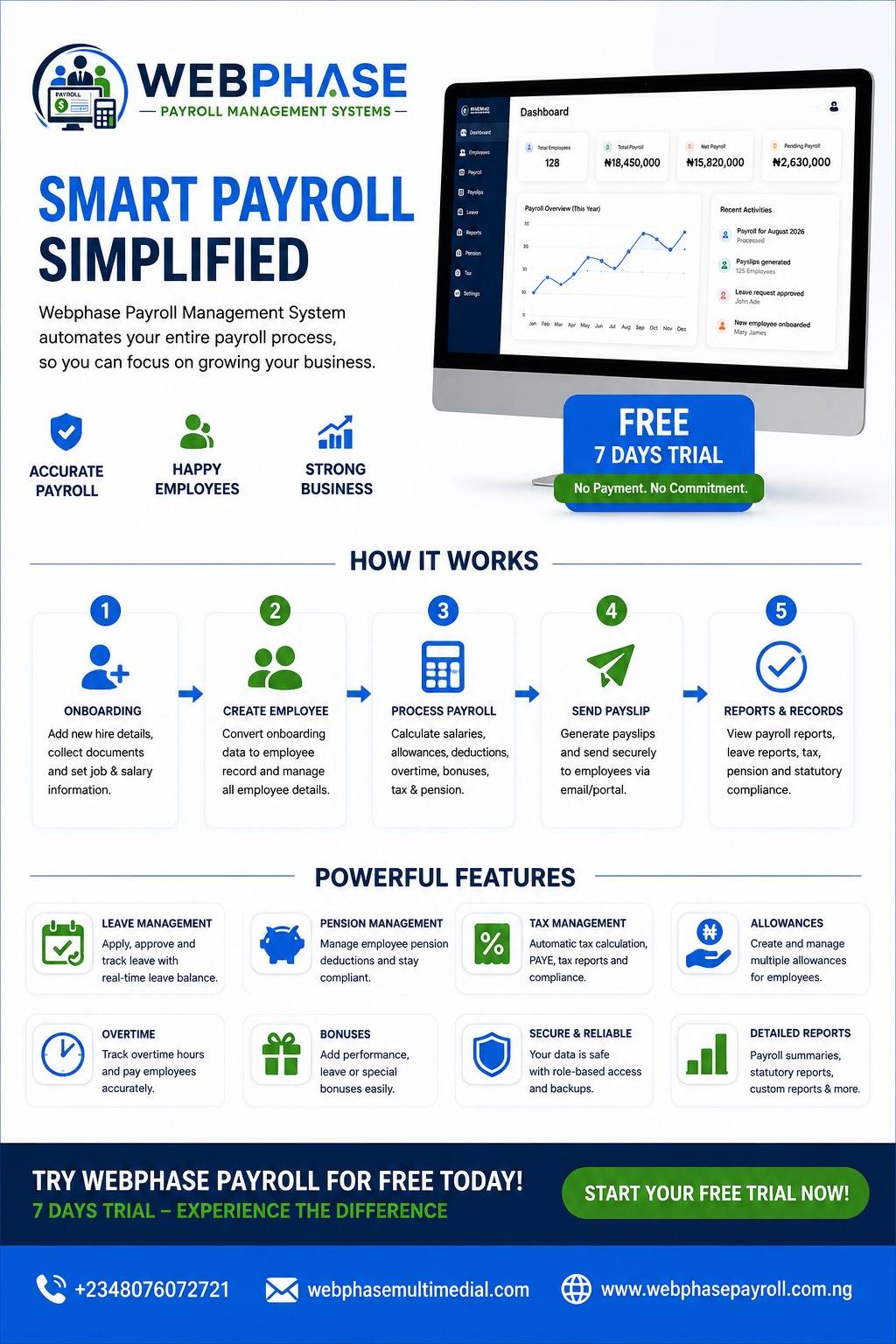
A well-built payroll management system typically automates the entire employee lifecycle from onboarding to reporting. That usually breaks down into five stages:
- Onboarding. New hire details, documents, and salary structure are captured once, at the start, instead of being re-entered across multiple spreadsheets.
- Employee record creation. Onboarding data converts directly into a live employee record, so HR isn’t maintaining the same information in two or three different places.
- Payroll processing. Salaries, allowances, deductions, overtime, bonuses, tax, and pension are calculated automatically based on the rules you set once, not re-derived by hand every cycle.
- Payslip distribution. Payslips are generated and sent securely to each employee, removing the awkward back-and-forth of manually emailing salary breakdowns.
- Reporting and compliance. Payroll history, leave records, tax filings, and pension reports are available on demand, which matters enormously the moment a regulator, auditor, or new finance hire asks “can I see last quarter’s numbers?”
The Features That Actually Matter
Not every payroll feature is equally important, but a few consistently make the biggest difference for growing teams:
- Leave management that tracks real-time balances, so approvals and payroll deductions stay in sync automatically.
- Pension management that handles contribution calculations and keeps records compliant without a separate manual process.
- Tax automation, particularly PAYE calculation and tax reporting, since this is where manual errors tend to be most costly.
- Flexible allowances, because very few companies pay a flat salary. Transport, housing, and other allowances all need to be configurable per employee.
- Overtime tracking that ties directly into pay calculations instead of being reconciled separately at month-end.
- Bonus handling for performance pay, leave payouts, or one-off rewards, without needing a manual adjustment each time.
- Role-based access and data security, since payroll data is some of the most sensitive information a company holds, and not everyone in the organization should see all of it.
- Detailed, exportable reports: payroll summaries, statutory reports, and custom breakdowns that HR and finance can pull without waiting on IT.
Why This Matters More as Companies Scale
The interesting thing about payroll pain is that it’s invisible until it isn’t. A company with 10 employees can survive on spreadsheets. A company with 100 usually can’t, not because the team got lazier, but because the number of edge cases (part-time staff, mid-month joiners, tax band changes, leave-without-pay days) grows faster than a spreadsheet can gracefully handle. Automation isn’t a luxury at that point; it’s what keeps payroll accurate and keeps the finance team sane.
There’s also a compliance angle that’s easy to underestimate. Nigerian tax and pension regulations don’t stay static, and a payroll system that’s built to reflect current statutory requirements removes a real source of legal and financial risk, something a static spreadsheet template simply can’t do on its own.
Building for This Problem
This is the space Webphase Multimedia works in: designing and building payroll management systems for Nigerian businesses that need accuracy without the manual overhead. As a developer working on tools like this, what stands out most isn’t the dashboard or the design (although those matter for usability); it’s how much invisible complexity sits underneath something as seemingly simple as “pay everyone correctly, on time, every month.” Getting tax logic right, keeping pension calculations compliant, and making sure reports are audit-ready: that’s the actual engineering challenge behind smart payroll software.
If you’re evaluating payroll systems for your business, the questions worth asking aren’t about flashy features. They’re about the fundamentals: does it calculate PAYE correctly for your state, does it handle pension remittance without manual intervention, can HR generate a compliance report in under a minute, and is employee data actually secure. Get those right, and the rest of payroll stops being a monthly fire drill and starts being what it should be: a background process that just works.
Swift Global Recruit
Swift Global Recruit (swiftglobalrecruit.com), based in Lagos, is a recruitment platform connecting job seekers with employers across industries and continents. On the candidate side, users build a profile, upload a CV, browse or search curated job listings, apply with one click, and track applications via a personal dashboard, with direct messaging to recruiters to schedule interviews. On the employer side, they’ve worked with businesses like Brokvine Hotel in Lagos, whose CEO described the process as smooth and reliable enough to keep using for ongoing hiring needs. They claim to have helped over 250,000 professionals find jobs.