
Early bird scholarship up to 25%
⚠ Alert: Offer available till 30th of September 2026
Programs features

Learning Formula
Hybrid/60% hands on lab

Intake
2 Times A Year

Language
English
Get to know about this short course and what it offers
Advanced Diploma in Cyber Security With Skill
Development Council (SDC), Canada
The Advanced Diploma in Cybersecurity is a high-intensity professional credential
delivered in collaboration with the Skill Development Council (SDC), Canada. This program is
designed for IT professionals and managers who need to architect secure digital environments.
It moves beyond theory into the technical strategy of defense, risk management, and digital
forensics.
Program Facts
- Multiple Certification: Skill development council canada, Docenti Global Business School and Uptitek Ltd, UK.
- Duration: 24 Weeks to 6 Months (480hrs).
- Format: 100% Online / Distance Learning, 60% hands on lab/assessment based and Skill-based.
- Tuition: ₦2,500,000 (Flexible installment plans available).
- Accreditation: Skill Development Council, Canada, ISO9001:2015.
Core Focus & Research Areas
The program focuses on high-level security domains:
- Information Security Governance: Architecting policies that protect global enterprises.
- Digital Forensics & Incident Response: Using scientific methodology to investigate andrecover from breaches.
- Network Security & Cryptography: Protecting the integrity of data in transit.
- Ethical Hacking & Penetration Testing: Proactively identifying vulnerabilities through rigorous testing.
Key Skills and Competencies
Threat intelligence and Network Security
Penetration Testing and Threat Hardening
Digital Forensicss & Incidence response
Risk Management
Vulnerabilty Assessment
DevSecOps
- North American Technical Benchmarks: Gain a diploma that reflects the high security standards of the Canadian tech industry, giving your resume an immediate international authority.
- In-Demand Technical Mastery: Graduate with a “ready-to-deploy” skill set, including Ethical Hacking, Digital Forensics, Risk Management, and AI-driven Threat Detection.
- Expert Technical Supervision for your capstone project: You are paired with senior cybersecurity architects and academic supervisors who guide your research into real-world threat vectors.
- The Research-to-Defense Pipeline: Your assessments aren’t just tests; they are evidence-based projects where you analyze and mitigate hypothetical or real-world security breaches.
- International Standards: Our curriculum is mapped to global frameworks (such as ISO 9001:2015), ensuring your technical skills are valid in any jurisdiction.
Multiple Certifications
Earn multiple globally recognized certifications upon completion — one from Docenti Global Business School, one from Optitek Ltd and another from the Skill Development Council (SDC), Canada. This multiple recognition enhances your international credibility and signals your readiness to excel in global cybersecurity and technology environments.
Professional Internship
Gain real-world cybersecurity experience through structured internships. Work on live security projects, apply classroom knowledge to practical scenarios, and develop the technical and analytical skills that employers value most.
Industry and Company Visits
Participate in guided visits to leading organizations and cybersecurity firms. These visits provide firsthand exposure to corporate systems, operational workflows, and professional cultures — helping you connect theory with industry practice while building valuable professional networks.
Global Study Tour / Bootcamp (Thailand & Rwanda)
Engage in international study tours and bootcamps in Thailand and Rwanda, exploring innovation hubs, tech accelerators, and cross-cultural learning environments. This global exposure demonstrates how cybersecurity and digital transformation are implemented in diverse economies.
CV and Portfolio Optimization
Receive expert guidance to craft a results-driven professional CV and digital portfolio that highlight your technical expertise, certifications, and accomplishments — giving you a competitive advantage in the global job market.
Professional Social Media Branding
Enhance your online presence on platforms such as LinkedIn. Learn to build a strong digital profile, showcase your cybersecurity skills, and attract recruiters and hiring managers worldwide.
Fast-Track Access to the Job Market
Leverage Docenti’s corporate partnerships and industry links for rapid access to job opportunities after graduation. Our career support team helps you transition seamlessly from learning to professional employment in cybersecurity and related digital roles.
International Networking Opportunities
Connect with a global community of cybersecurity professionals, experts, and alumni. Participate in workshops, collaborative projects, and online forums to expand your network and gain international insights.
Business Incubation and Innovation Support
For entrepreneurial learners, the Docenti Innovation Hub provides mentorship, tools, and resources to transform cybersecurity ideas into viable business solutions. Learn how to develop, pitch, and scale innovative tech ventures.
Corporate Engagement and Industry Exposure
Interact directly with cybersecurity leaders, HR executives, and industry practitioners through seminars, interactive sessions, and conferences. These experiences enhance your visibility and deepen your understanding of real-world cybersecurity challenges.
Employer Connections and Job Placement
Benefit from Docenti’s strong partnerships with leading organizations seeking skilled cybersecurity professionals. Our placement support connects you with roles such as cybersecurity analyst, IT auditor, and digital risk specialist.
Career Services and Coaching
Access continuous career guidance, including mock interviews, job search strategies, and one-on-one coaching. Our advisors help you navigate your career path and achieve professional growth.
One-Year Access to Docenti LMS
Enjoy 12 months of post-completion access to Docenti’s Learning Management System (LMS). Revisit course materials, explore new resources, and continue learning at your own pace.
Exclusive Discounts on Future Programs
Advance your career with special discounts on all Docenti programs and selected partner institution courses — promoting lifelong learning and continuous skill development.
Personalized Coaching and Mentorship
Work closely with experienced mentors and industry experts who provide actionable insights and guidance. Receive support to grow academically, professionally, and personally throughout your cybersecurity journey.
Self-Branding and Professional Identity Building
Develop a strategic professional identity in the cybersecurity field. Identify your strengths, craft your narrative, and position yourself as a credible and confident digital security professional.
Free Global Webinars and Expert Sessions
Stay ahead of industry trends through live webinars hosted by international cybersecurity experts. Learn about ethical hacking, data privacy, digital risk management, and emerging technologies shaping the future of cybersecurity.
1. Develop advanced cybersecurity knowledge
- Build deep practical understanding of cybersecurity concepts, systems, and architectures.
2. Secure digital systems and infrastructure
- Gain the ability to protect networks, systems, and information assets in complex organizational environments.
3. Apply practical cybersecurity skills
- Acquire hands-on technical competencies through lab-based and applied learning (hybrid, practical training approach).
4. Analyze and manage cyber threats
- Develop strong analytical capability to identify, assess, and respond to cybersecurity risks and threats.
5. Build specialized technical expertise
- Progress from intermediate to advanced cybersecurity practice, mastering tools, techniques, and frameworks.
6. Implement strategic security management
- Learn to design and manage security strategies within organizations, aligning cybersecurity with business goals.
7. Prepare for professional cybersecurity roles
- Be equipped for roles across industries like finance, government, healthcare, energy, and tech.
8. Enhance problem-solving and decision-making
- Strengthen the ability to make informed security decisions in real-world, complex environments.
Duration: 24 weeks-6 months (480 hours)
Delivery: 60% hands on lab/assessment based
Capstone Project: 2 months (Quality Supervision)
Internship: 2 Month
Classes: Saturdays (10:00am – 03:30pm) & Sundays (01:00pm – 05:00pm)
Learning Format: Hybrid
Multiple Certification: Skill development council canada, Docenti Global Business School & Uptitek Ltd, UK.
Tuition: ₦2,500,000
Eligibility:
- 2+ years in IT/cybersecurity or equivalent foundational certification (e.g., Security+, CEH)
- Working knowledge of networking (TCP/IP, routing, firewalls)
- Basic Linux/Windows system administration
- Fundamental programming skills (Python, Bash, or PowerShell recommended)
- Understanding of security concepts (CIA triad, encryption basics)
Program Completion
- Complete all 6 modules with minimum 70% score on each
- Submit all module capstone projects and achieve passing grades
- Complete minimum 80% of mandatory lab exercises
- Pass final practical assessment: security audit + pentest + IR
simulation
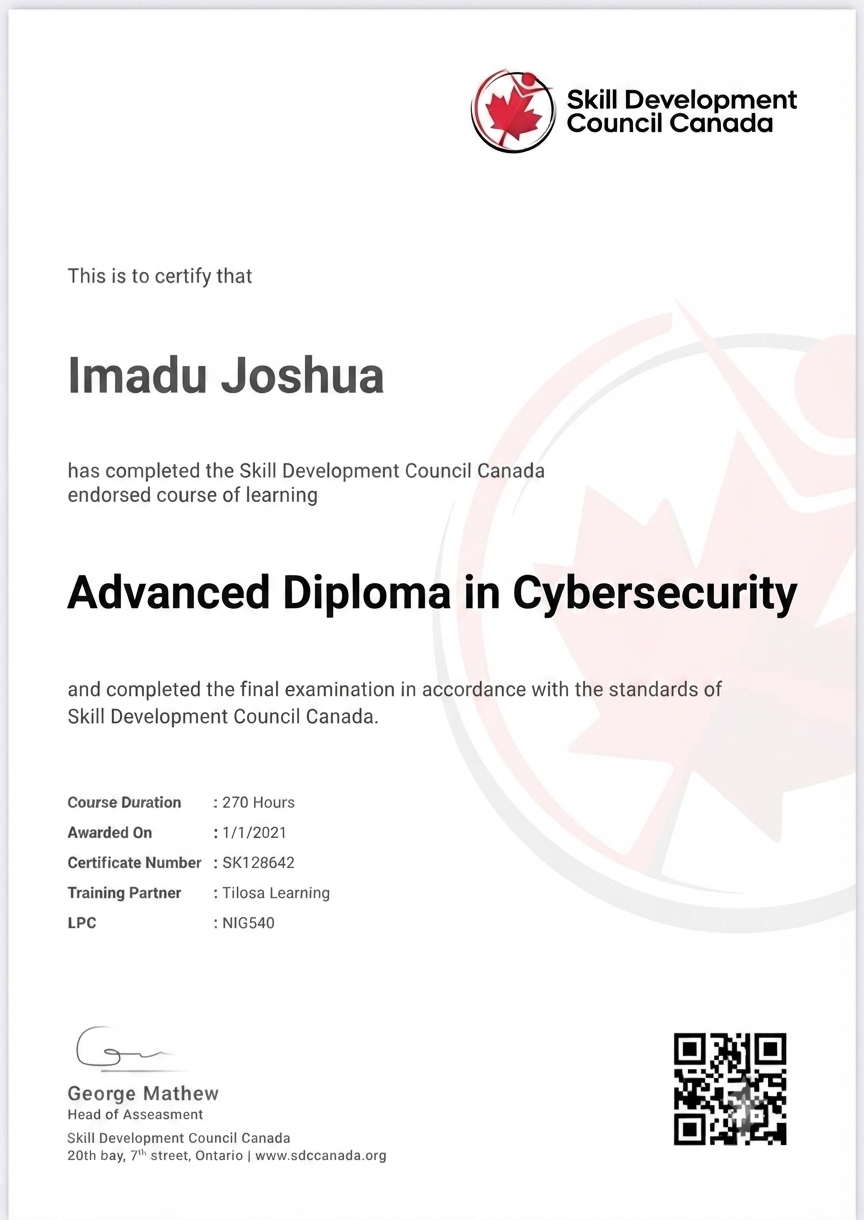
Advanced Diploma in Cybersecurity from SDC Canada
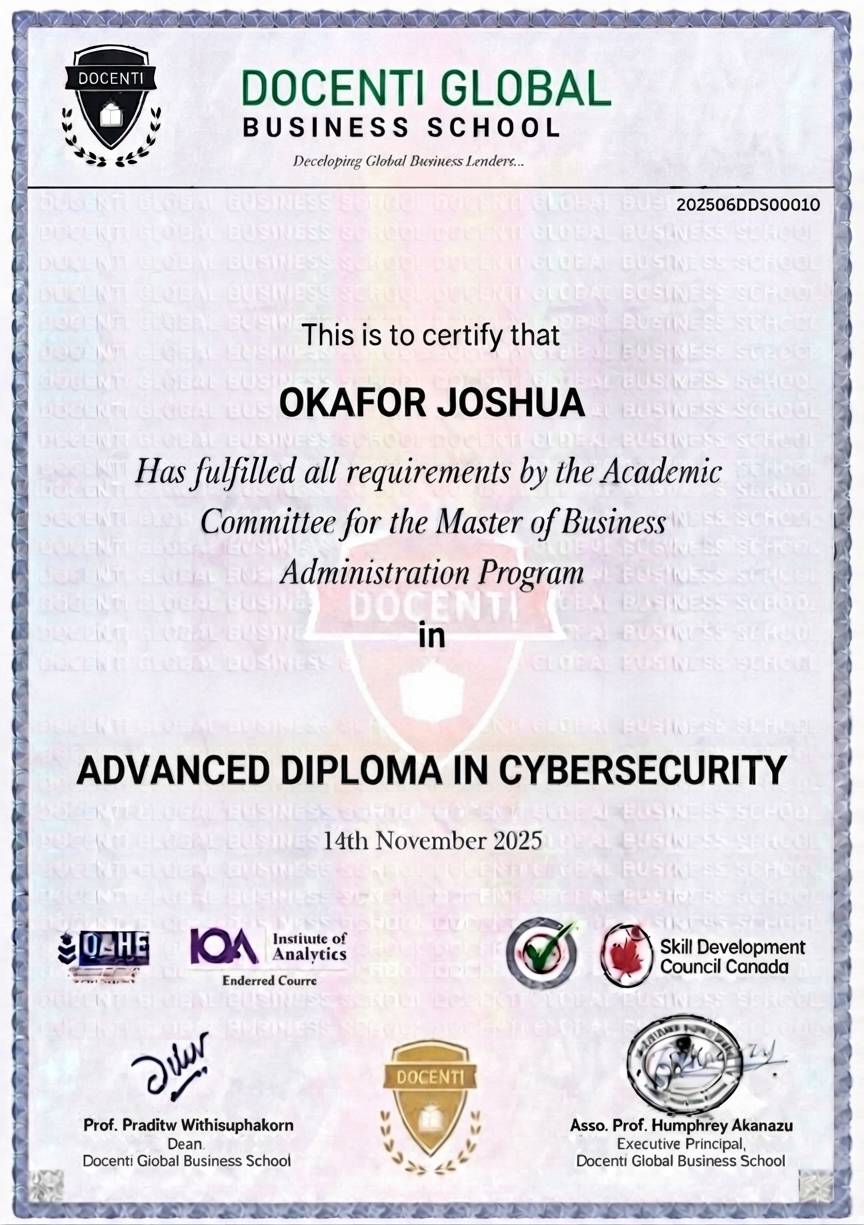
Advanced Diploma in Cybersecurity Program certificate from Docenti Global Business School
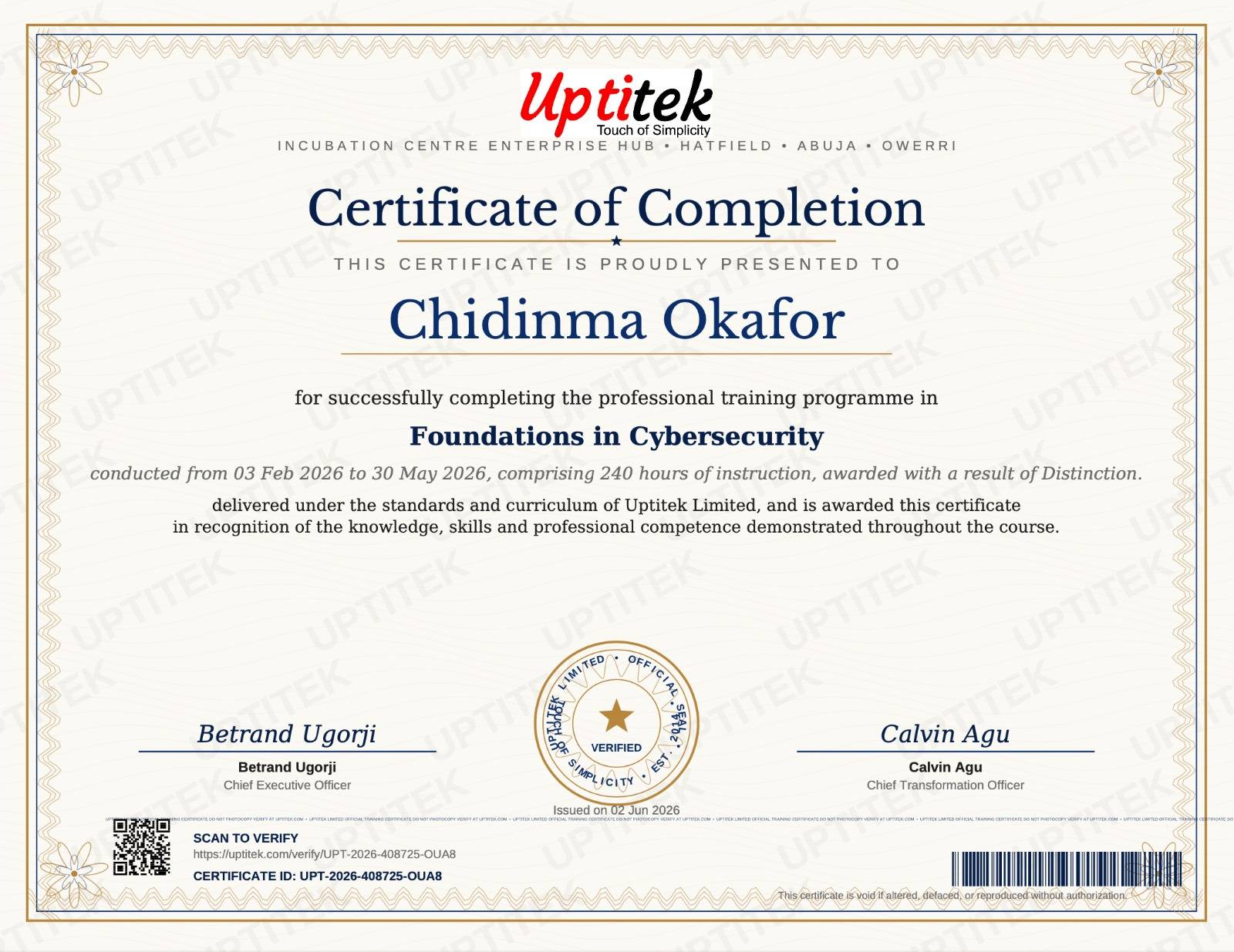
Uptitek UK Certificate for Advanced Diploma in Cybersecurity
Key Tools and Labs
From practical classes to certificates
Hands-on sessions are facilitated by industry experts walking the students through from beginner levels of cybersecurity and tools to the advanced level
Cyber
Security
Security
MISP | Maltego
Shodan
theHarvester |
ATT&CK Navigator
| ThreatConnect
| AlienVault OTX
Shodan
theHarvester |
ATT&CK Navigator
| ThreatConnect
| AlienVault OTX
GNS3/EVE-NG |
Cisco ACI
Simulator |
pfSense | Zeek |
Wireshark | AWS
VPC | Azure
Virtual WAN
Cisco ACI
Simulator |
pfSense | Zeek |
Wireshark | AWS
VPC | Azure
Virtual WAN
Autopsy |
Volatility | FTK
Imager | Sleuth
Kit | OSQuery |
CrowdStrike Falcon
| Splunk
Volatility | FTK
Imager | Sleuth
Kit | OSQuery |
CrowdStrike Falcon
| Splunk
Metasploit | Burp
Suite Pro | Cobalt
Strike |
BloodHound |
Mimikatz |
HackTheBox |
TryHackMe
Suite Pro | Cobalt
Strike |
BloodHound |
Mimikatz |
HackTheBox |
TryHackMe
Terraform |
Checkov | Docker
| Kubernetes |
Prisma Cloud |
AWS / Azure /
GCP Free Tiers
Checkov | Docker
| Kubernetes |
Prisma Cloud |
AWS / Azure /
GCP Free Tiers
Splunk
Enterprise
Security |
TheHive |
Cortex XSOAR |
Cyber Range
Simulations
Enterprise
Security |
TheHive |
Cortex XSOAR |
Cyber Range
Simulations
MODULES
MODULE 1: Cyber Threat Intelligence & Adversary Analysis (Duration: 4 weeks (80 hours)
Overview:
Master the identification, analysis, and tracking of advanced persistent
threats (APTs), nation-state actors, and cybercriminal organizations.
Learn to leverage threat intelligence platforms and frameworks to
anticipate and disrupt adversary operations
Learning Outcomes
- Analyze APT campaigns using MITRE ATT&CK framework
- Deploy and configure threat intelligence platforms (MISP, STIX/TAXII)
- Conduct OSINT investigations for adversary profiling
- Execute hypothesis-driven threat hunting in enterprise environments
- Develop predictive threat models for proactive defense
Weekly Breakdown
Threat Landscape & APT Tactics
- APT groups and TTPs analysis using MITRE ATT&CK framework
- Ransomware-as-a-Service (RaaS) ecosystem analysis
- Lab: Map real-world breach to ATT&CK techniques
Threat Intelligence Platforms
- STIX/TAXII protocol implementation
- TIP configuration (MISP, ThreatConnect)
- Lab: Build automated threat feed aggregation pipeline
OSINT & Attribution
- Advanced OSINT techniques (Maltego, theHarvester, Shodan)
- Adversary infrastructure tracking and attribution challenges
- Lab: Conduct OSINT investigation on simulated threat actor
Threat Hunting & Predictive Analysis
- Hypothesis-driven threat hunting methodologies
- Behavioral analytics and anomaly detection
- Lab: Execute threat hunt in enterprise network simulation
Required Tools & Resources:
Software: MISP, Maltego, Shodan, theHarvester, ATT&CK Navigator
Platforms: ThreatConnect, AlienVault OTX
Reading: MITRE ATT&CK documentation, NIST SP 800-150
Module Assessment:
Capstone Project: Comprehensive threat intelligence report analyzing a
recent APT campaign, including TTPs mapping, IOC extraction, and
defensive recommendations (15-20 pages)
MODULE 2: Zero Trust Architecture & Secure Network
Design
Duration: 4 weeks (80 hours)
Overview:
Design and implement Zero Trust security models for modern
infrastructures including software-defined networking (SDN), multi-cloud environments, and IoT/OT convergence
Key Topics
- Zero Trust principles and NIST SP 800-207 implementation
- Software-defined networking with OpenFlow and Cisco ACI
- Micro-segmentation strategies to prevent lateral movement
- IoT/OT security and Industrial Control Systems protection
- ML-based network telemetry and anomaly detection
Required Tools:
GNS3/EVE-NG, Cisco ACI Simulator, pfSense, Zeek, Wireshark, AWS VPC,
Azure Virtual WAN
Capstone Project:
Design complete Zero Trust architecture for fictional enterprise with network
diagrams and security policies
MODULE 3: Enterprise System Hardening & Digital
Forensics
Duration: 4 weeks (80 hours)
Overview
Harden enterprise operating systems and conduct forensic investigations on compromised systems. Master endpoint detection and
response (EDR) and evidence preservation.
Key Topics:
- Windows and Linux hardening using CIS benchmarks
- SELinux/AppArmor and exploit mitigations (ASLR, DEP)
- EDR deployment and SIEM integration
- Digital forensics with disk imaging and timeline reconstruction
- Memory forensics using Volatility framework
Required Tools:
Autopsy, Volatility, FTK Imager, Sleuth Kit, OSQuery, CrowdStrike Falcon, Splunk.
Capstone Project:
Complete forensic investigation report with timeline reconstruction and
chain-of-custody documentation
Module 4: Advanced Penetration Testing & Red Team
Operations
Overview:
Execute full-spectrum penetration tests using red team methodologies.
Develop custom exploits, evade modern security defenses, and simulate APT-style campaigns.
Key Topics:
- Advanced reconnaissance and OSINT for pentesting
- Web application and API security testing (OWASP Top 10)
- Active Directory exploitation (BloodHound, Kerberoasting)
- Custom payload development and AV/EDR evasion
- Command & Control frameworks (Cobalt Strike, Empire)
Required Tools:
Metasploit, Burp Suite Pro, Cobalt Strike, BloodHound, Mimikatz,HackTheBox, TryHackMe.
Capstone Project:
Complete penetration test with executive summary, technical findings, and
remediation playbook (25-30 pages)
Module 5: Cloud-Native Security & DevSecOps
Duration: 4 weeks (80 hours)
Overview:
Secure cloud-native applications and infrastructure across AWS, Azure, and GCP. Implement DevSecOps practices including Infrastructure-as-
Code security and container orchestration
Key Topics:
- Multi-cloud IAM and least-privilege access controls
- Infrastructure-as-Code security scanning (Terraform, Checkov)
- Container and Kubernetes security (RBAC, Pod Security)
- Serverless and API Gateway security
- Cloud compliance (CSA CCM, FedRAMP, ISO 27017)Required Tools:
Terraform, Checkov, Docker, Kubernetes, Prisma Cloud, AWS/Azure/GCP Free Tiers
Capstone Project:
Deploy secure cloud-native application with IaC, compliance checklist, and automated security testing
Module 6: Incident Response, Recovery & Business
Continuity
Duration: 4 weeks (80 hours)
Overview:
Lead enterprise-scale incident response operations from detection through recovery. Master SOAR automation, forensic analysis, and business continuity planning.
Key Topics:
- Incident response frameworks (NIST 800-61, SANS methodology)
- SIEM alert triage and containment strategies
- SOAR platforms and automated response workflows
- Advanced log analysis and root cause determination
- Business continuity planning and ransomware recovery
Required Tools:
Splunk Enterprise Security, TheHive, Cortex XSOAR, Cyber Range simulations.
Final Capstone:
Lead simulated enterprise incident response with live containment, forensic analysis, and post-incident report
Certifications & Accreditations
Docenti Global Business School is accredited by QAHE (ISO 17011:2017)
Recognized by the American Accreditation Association (AAA)
Accredited by the Skill Development Council, Canada (SDC) & Uptitek Ltd UK.
Career Services Beyond Classroom
01
Coaching and Mentoring
Receive one-on-one guidance from career advisors who will help you define your career goals, identify growth opportunities, and develop a clear roadmap for success in Cyber Security
02
Cv Review and Linkedin Optimization
Our career experts will review and optimize your CV and LinkedIn profile to showcase your skills, projects, and achievements, increasing your visibility to recruiters and employers.
03
Career Acceleration workshops & Webinars
Participate in exclusive workshops and industry-led webinars focused on interview preparation, personal branding, networking, job search strategies, and emerging industry trends.
04
Internship & fulltime Job Placements
Gain access to internship and employment opportunities through our employer network, with ongoing support throughout your application and placement journey.
05
Module Specific Coaching & Mentoring
Receive personalized academic support throughout your programme, with dedicated coaching sessions to help you master each module, overcome challenges, and successfully complete practical projects and assessments.


ALP Code 1195

 Docenti’s School of Entrepreneurs

Kindly Fill Out The Form If You Haven't to Apply Now
Testimonials
Olamide Sobayo

Learning employability skills with Docenti over the past three months has been an eye-opening experience. The classes are not just theoretical; they are practical and relatable, tailored to help me… Read more “Olamide Sobayo”
Olamide Sobayo
Sekinat

For anyone serious about growth, Docenti Global Business School is the place to be. My learning journey in the school proved incredibly insightful. I actively learned, consciously unlearned, and effectively… Read more “Sekinat”
Sekinat
Gbadebo Elizabeth

Docenti Global Business School has helped me develop my career and my business mindset. Interactions with Students and Lecturers are fantastic. DGBS is a fantastic place to learn and develop… Read more “Gbadebo Elizabeth”
Gbadebo Elizabeth
Green Evans

I joined the Docenti Business school graduate program early this year, and so far, it has been nothing short of wonderful. The program has been made for us to have… Read more “Green Evans”
Green Evans
Frequently Asked Questions
How does the Advanced Diploma differ from a foundational cybersecurity program?
While foundational courses cover basic security concepts, the Advanced Diploma dives straight into enterprise-level engineering and deep execution frameworks. It bypasses basic IT theory to focus intensely on advanced multi-layered network defense, complex penetration testing methodology, threat hunting architectural structures, and large-scale incident response workflows.
What are the global accreditations backing this advanced program?
To ensure your advanced qualification commands premium global value, this program features triple international validation. The curriculum is fully aligned and accredited by the International Organization for Standardization (ISO), the Institute of Analytics (IoA), Skill Development Council Canada (SDC Canada) & Uptitek Limited UK. This elite level of credentialing makes your qualification instantly portable across major international tech markets.
What specific enterprise tools and languages will I master?
This is an elite, hands-on engineering program. Throughout your training, you will work directly with industry-standard cybersecurity engineering tools, including:
Offensive Security: Advanced exploitation frameworks via Kali Linux, Burp Suite Pro, and Metasploit.
Defensive Operations: SIEM engineering, log analysis, and threat detection using Splunk, Wireshark, and open-source intelligence (OSINT) tools.
Automated Security: Writing advanced scripts in Python and Bash to automate network monitoring and defensive configurations.
Are there specific entry requirements to enroll in the Advanced Diploma?
Because this program covers complex, mid-to-senior level security engineering frameworks, applicants should ideally possess:
A basic foundational background in IT, networking protocols, or computer science.
Alternatively, completion of an introductory cybersecurity track or equivalent practical experience handling operating systems (Linux/Windows).
Can I balance this advanced program alongside my full-time work commitments?
Yes. The program is built around Docenti Global's flexible blended learning ecosystem. You can access elite virtual hacking labs, masterclasses, and recorded instructional modules on a schedule that fits your professional lifecycle, allowing you to scale your skills without pausing your monthly income.
How does the practical lab infrastructure function?
You will not be sitting through passive, theoretical PowerPoint slides. You will be deployed directly into our secure, cloud-based sandbox virtual cyber environments. These labs safely simulate real corporate network infrastructure breaches, live malware injection scenarios, and firewall failures, giving you the practical battlefield experience corporate recruiters actively demand.
What senior job roles can I secure with this Advanced Diploma?
The global market faces a massive deficit of advanced, high-level cybersecurity talent. Upon graduation, your portfolio and credential will qualify you to step confidently into high-paying local or remote roles such as:
Senior Cybersecurity Analyst / SOC Team Lead
Enterprise Penetration Tester / Ethical Hacker
Information Security Engineer
Cyber Threat Hunter
Incident Response Manager
Does this program prepare me for major international vendor certifications?
Absolutely. The Advanced Diploma's structural curriculum is rigorously mapped directly to the body of knowledge required to pass top-tier global examinations. By completing this course, you will be technically primed and fully prepared to sit for elite certifications such as CompTIA Security+, CompTIA PenTest+, Certified Ethical Hacker (CEH), or specialized cloud security engineering tracks.