Early bird scholarship up to 25%
⚠ Alert: Offer available till 30th of September 2026
Features of MBA in International Business

Learning Formula
Online/On Campus

Intakes
April/October

Language
English
Get to know more about the MBA in International Business
MBA in International Business with European Global Institute of Innovation
and Technology
The MBA in International Business is built to turn professionals into globally minded business leaders. It goes well beyond standard business management; this is an EQF (European Qualifications Framework) Level 7 European Master’s degree centred on global strategy, cross-border trade, and international market operations.
The program runs online & On Campus, so you can earn a respected European degree while still leading in your organisation, wherever you’re based, including Nigeria. You get the same curriculum and global accreditation as on-campus programs in Europe, minus the expense of travel or relocation.
Key Academic Facts
- Credit Weight: 90 ECTS (European Credit Transfer and Accumulation System)
- Academic Level: Level 7 Master’s Degree (European Qualifications Framework)
- Duration: 12 to 18 months
- Structure: Core MBA modules, international business specialisation, and a final research project
- Accreditation: Accredited by the Malta Further and Higher Education Authority (MFHEA), evaluated by WES, and recognised internationally
- Tuition: ₦4,000,000.00
- Why Choose Us?
- Benefits
- Learning Outcomes
- Engaging Program Content
- Learning Support
- Program Structure
- Program Awarding Institutions and Title
- Program Completion
- Career Pathways
- Faculty
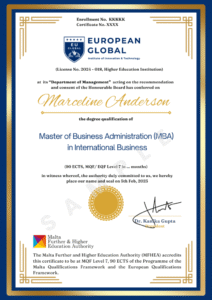
- Sample Certificate
Why International Business with European Global Institute of Innovation and Technology?
- From Operator to Strategist: Move your career from day-to-day business operations to becoming a key strategic voice in global expansion decisions.
- Global Credentials, Local Currency: Earn a degree accredited in the EU while paying in Naira. You save significantly on foreign exchange costs and living expenses by choosing our distance-learning model.
- Work Integrated Learning: Our case studies centre on real global business challenges, so you can apply international business practices directly to your current role in a Nigerian or multinational company.
- Elite Global Network: Connect with a diverse cohort of business leaders and executives from around the world, growing your professional reach well beyond local borders.
Research-Based Capstone Project & Quality Supervision (ISO9001:2015)
The 90-credit hour program is built around real case studies and established global business frameworks, helping you move from instinct-driven choices to strategies backed by solid market and economic data.
- Personalised Supervision: You’ll work closely with a doctoral-level supervisor who guides you in designing and carrying out a research project focused on a real international business challenge.
- Research Rigour: You’ll be supported through the process of gathering and analysing market or organisational data, ensuring your final thesis meets recognised international academic and professional standards.
- The Mark of Excellence: Completing this research demonstrates your ability to manage complex global business challenges, positioning you as a strong candidate for international firms.
Core Research & Specialisation Areas
Students can focus their research on some of the most pressing issues in global business today:
- Digital Transformation & Global Trade: Navigating the shift toward AI-driven operations and digital-first international trade.
- Global Market Entry & Expansion: Strategies for entering and scaling in new markets across different regions and economies.
- Cross-Border Strategy & Change Management: Managing mergers, acquisitions, and organisational shifts in unpredictable global markets.
- International Finance & Risk Management: Designing data-led financial strategies that manage risk and drive performance across borders.
Benefits:
- Designed for experienced executives aged 25 and above (minimum 2 years of work experience).
- Earn a prestigious degree with WES recognition.
Fully accredited by the Council for Higher Education Development (USA) and approved by the Malta Further & Higher Education Authority (MFHEA). - 90 ECTS, recognized as a Level 7 full-degree programme under the Malta Qualifications Framework (MQF) / European Qualifications Framework (EQF).
- International immersion and global business matching in Portugal, Spain, Thailand, Kigali, China, Malta, and Canada.
Implementation-based programs with a collaborative learning approach. - Focus on Industry 4.0 trends and business management technologies.
- Flexible payment options available.
- Full access to the E-Campus, E-Library, and LMS of the European Global Institute of Innovation and Technology.
Learn from an international faculty team with 20+ years of industry experience. - Study real-world global case studies for practical insights.
Consistently receives excellent reviews from graduates.
Dedicated supervisors for personalized guidance. - Internship placement and career support services.
- Exclusive access to the European Global Institute of Innovation & Technology alumni network.
- Business mentoring from industry leaders.
- ISO certified academic supervision system.
- Globally recognized European degree.
- Prepare to become a global business leader.
After the programme, learners will be able to:
Professional Application (PA)
- PA1: Critically assess complex and uncertain business situations, drawing on multiple disciplines to make sound strategic decisions even when information is incomplete.
- PA2: Respond effectively to fast-changing business environments, particularly within international business, by setting clear criteria, developing innovative solutions, applying adaptable strategies, and assessing outcomes under uncertain conditions.
- PA3: Show strong leadership and team-building abilities in multicultural settings, managing conflict and engaging stakeholders effectively, especially in international business contexts.
- PA4: Take ownership of continuous learning and professional growth through reflection, using research-based insights to address emerging challenges in international business.
- PA5: Set strategic benchmarks, guide teams, track performance, and drive ongoing improvement across varied business settings, in line with international business best practices.
- PA6: Work through ethical dilemmas involving competing stakeholder interests and cross-border complexities, while maintaining strong ethical standards and corporate governance in international business.
- PA7: Carry out thorough business research, critically reviewing existing literature, applying advanced research methods, and contributing meaningful findings to the field of international business.
Knowledge Outcomes (PB)
- PB1: Critically assess how contextual factors (legal, ethical, economic, environmental, social, technological, international, and governance-related) influence organisations and management functions.
- PB2: Combine knowledge from finance, technology, ethics, and data analytics to support well-rounded financial decision-making within international business and organisational success.
- PB3: Critically evaluate effective international business strategies, drawing on technology, ethics, and data analytics to improve organisational performance.
- PB4: Develop and apply adaptable business policies and strategies within international business or general management, using current theoretical and practical knowledge.
- PB5: Critically examine and improve production and marketing processes using advanced problem-solving approaches, with a focus on decision-making in international business.
- PB6: Build and adjust business frameworks to anticipate shifts in markets, organisations, and industries, particularly within an international business context.
- PB7: Critically review academic literature, apply research methods, and develop new frameworks at the forefront of international business and management studies.
- PB8: Assess and apply ethical leadership, corporate governance, and sustainability practices to support responsible business conduct in international business.
- PB9: Draw on specialised international business knowledge to address specific challenges and opportunities within the field.
Note: PB1 to PB7 are required for diploma exit; PB1 to PB9 are required for the full Master’s degree (see exit awards for details).
Skills Outcomes (PC)
- PC1: Critically assess and bring together complex, multidisciplinary data to produce practical insights, taking social, cultural, and environmental impacts into account within international business.
- PC2: Use advanced quantitative and qualitative research methods to examine business challenges, producing original, evidence-based conclusions in changing international business contexts.
- PC3: Communicate research findings clearly and effectively, showing leadership in stakeholder engagement, negotiation, and decision-making across a range of settings.
- PC4: Pursue innovation, adaptability, and strategic thinking to support professional growth, continuous learning, and competitive advantage.
- PC5: Lead high-performing teams through collaboration, critical thinking, and transformative decision-making in complex international business environments.
Engaging Programme Content:
Video Lectures:
Pre-recorded lectures you can watch at your convenience.
Interactive Modules:
Multimedia content with quizzes, exercises, and simulations to reinforce learning.
Live Webinars:
Real-time sessions with faculty for lectures, Q&A, and discussions (often recorded for later viewing).
Guest Speakers:
Industry experts sharing insights and real-world perspectives.
We Support Learning
Collaborative Learning:
Online discussions, group projects, and peer feedback are common to foster interaction and knowledge sharing.
Active Learning:
You will be actively involved in the learning process through discussions, problem-solving, and applying concepts to real-world cases.
Modern Technology-Enhanced:
Online platforms provide access to resources, communication tools, and learning materials 24/7.
Global Community:
Interact with classmates from diverse backgrounds and locations, broadening your perspectives.
Programme Details
- Accelerated – 1 Year
Full-time – 18 Months
Part-time – upto 3 years - Start Date:
1st working day of every month - Application Due Date:
Ongoing - ECTS Credits:
90 ECTS Credits - Language:
English - EQF Level:
Masters Degree, Level 7 - Weekly Hours:
15-40 Hours per week - Teaching:
Asynchronous, Live MasterCamps - Tuition: 4, 000, 000.00
Learning Method
Asynchronous/Blended Learning: Delivered through the E-Campus of European Institute of Innovation and technology and Docenti LMS (Learning Management System) with live classes conducted via virtual conferencing platforms.
Coursework-Based Curriculum
- Assessment: Assignment, Capstone Project
- Collaborative Learning: Opportunity to connect and work with peers worldwide through webinars.
The content is specially procured by highly experienced professors and industry experts’ team for you to learn 24X7.
This programme can be studied anywhere in the world and earn globally reputed MQF/EQF accredited degree.
Eligibility
The following scanned copies of the documents are required to be provided to be admitted for the program.
- Biopage of your valid passport, National ID card or Driving License.
- Bachelor’s academic transcript and degree certificate in any discipline OR equivalent completion of Level 6 qualification with at least 180 ECTS, HND or a four-year undergraduate degree.
- The applicant must have studied Mathematics at least MQF level 5 (Undergraduate Diploma/Certificate or OND in statistics or done our Skill Development Program in Data Science Diploma) or equivalent knowledge of mathematics (for instance, linear algebra, calculus).
- 200-300 words Statement of Purpose/Motivational Letter.
- Scan of passport size photograph.
Awards/Qualifications
Our strategic accreditation allows every learner to earn ECTS credits for every module they study. This allows students to take deferrals, exits and re-join studies and use same ECTS credits for an advanced entry into the programme.
- Award: MBA in Strategic Human Resource Management from European Global Institute of Technology and Innovation, Malta.
- Certificate of Completion for LifeLong Learning in MBA in Strategic Human Resource Management from Docenti Global Business School.
Awarding Body:
- European Global Institute of Technology and Innovation.
- Each module is expected to be completed in 5 weeks when studied full-time, and 8-10 weeks when studied part-time. The full-time and part-time modes will follow the same structure, the only difference will be related to weekly learning hours spent as stated in the duration in the above section.
- MBA in Strategic Human Resource Management/ 90 ECTS: Students have to complete all three semesters. The 3 Semester can also be compressed in 12 months.
Capstone Consulting Project
The Capstone Consulting Project is the final milestone of your MBA in International Business. This practical, hands-on project lets you apply advanced business strategies to real organisational challenges by working alongside industry partners to solve pressing issues in global business operations.
Project Overview:
Work in teams to tackle real-world international business challenges faced by corporate partners.
Develop actionable solutions for:
- Market entry and expansion strategies
- Cross-border organisational development and change management
- International trade and supply chain challenges
- Global performance and operations management
- Business analytics and data-driven decision-making
Learning Outcomes:
Upon successful completion of the Capstone Consulting Project, graduates will have developed the following key competencies.
- Strategic Problem-Solving in International Business
- Diagnose complex organisational and market challenges through systematic analysis.
- Develop innovative solutions that drive measurable business results across borders.
- Evaluate multiple approaches to select the most effective international business strategies.
- Advanced Project Leadership in Global Business
- Apply agile methodologies to execute international business initiatives efficiently.
- Lead diverse, multicultural project teams to deliver impactful business solutions.
- Manage every stage of a project, from initial concept through to final evaluation.
- Executive Communication & Influence
- Present compelling business cases to senior leadership and stakeholders.
- Translate complex business concepts into clear, strategic language.
- Influence organisational decision-making through data-driven insights.
- Change Management Expertise
- Design thorough change management frameworks for international business transformations.
- Measure and report on the return on investment of strategic business initiatives.
- Address resistance to change within organisations operating across borders.
- Global Business Leadership
- Develop culturally aware business solutions suited to multinational organisations.
- Navigate complex international trade regulations and compliance requirements.
- Implement global business strategies that remain adaptable to local markets.
Total Number of ECTS for this Module/Unit
- 18 ECTS
Relationship to Occupation/s
Learners who successfully achieve the outcomes of this programme can pursue the following career paths:
Career Path – Job Description
- International Business Director / Head of Global Operations – Oversee market expansion, operational strategy, and cross-border business initiatives.
- Chief Executive Officer (CEO) / Chief Operating Officer (COO) – Lead overall business strategy, growth planning, and organisational development on a global scale.
- Global Business Development Manager – Manage international partnerships, market entry strategies, and cross-border business relationships.
- International Trade Consultant – Advise organisations on trade policy, export strategy, and regulatory compliance across markets.
- Business Strategy Consultant – Drive strategic planning, market analysis, and performance optimisation for organisations operating globally.
- International Finance Manager – Oversee financial planning, risk management, and investment strategy across international markets.
- Business School Professor / Lecturer – Teach and conduct research in international business, global strategy, or management.
- Global Market Research Analyst – Conduct market research, competitive analysis, and industry trend forecasting across international markets.

RAYMOND OKORO
FACULTY MEMBER DOCENTI GLOBAL BUSINESS SCHOOL
Okoro Raymond, Ph.D. Technology Executive, Digital Transformation Leader With 17+ years of experience, Dr. Okoro drives innovation and digital transformation. As CIO (Novatrack) and CTO (Softworldinc), he leads engineering teams, DevOps, and Big Data/AI-driven logistics and enterprise systems.His expertise in Digital Transformation, Big Data Analytics, and enterprise automation has impacted 20M+ users worldwide. Dr. Okoro has led initiatives in edtech, fintech, ERP, and SaaS, and is dedicated to mentoring the next generation of tech leaders.

HUMPHREY OKECHUKWU AKANAZU (Ph.D)
Program Director
Dr. Akanazu is a Researcher, a Social Entrepreneur, and an Educationist who comes from a rich background of Management Education where he has had most of his career. He has three Master Degrees from various reputable European universities namely from the prestigious Roma Tre University (Rome – Italy) with a Master in Social Services Management; from the University of St. Bonaventure (Rome-Italy) with Master in Peace Building Management and a Master in Marketing and Communication from Rome Business School, Italy.

MATHEW NESIAYALI
FACULTY AND MEMBER OF THE ADVISORY BOARD
Matthew Nesiayali, a Nigerian techpreneur and co-founder of Syncware Limited, is a junior software developer and data analyst with over 19 years of leadership experience across various industries. He has held key roles such as Director of People and Organization at Syncware Limited, Divisional HR Manager at AOS Orwell Limited, and Manager of Performance Management at Port Harcourt Electricity Distribution Company. Nesiayali’s passion for delivering high-impact training programs on topics like data analytics, data ethics, and human resource management makes him an asset to any global business venture.

DR CHIZOBA NWABUNIKE FACULTY MEMBER DOCENTI GOBAL BUSINESS SCHOOL
Dr. Chizoba Nwabunike is a passionate and accomplished marketing and business leader with over 20 years of experience working across top brands in FMCG, betting, telecom, and fintech. Known for her creativity and strategic thinking, she has successfully led brand turnarounds and driven strong business growth. She holds a PhD in Business Administration, an MSc in Innovation Marketing, and an Executive MBA. As Managing Director of Rue Sage Media and Osis Foods Limited, and a Fellow of CIM, she blends deep academic knowledge with real-world leadership and executional excellence.
MBA in Internation Business Management
Program Journey
From Pre-Master to Graduation
How students progress through the MBA – from the Pre-Master's to the classes and coursework, capstone defense and finally the certificate issuance
1
2
3
4
1
Pre-Master Courses (BLEP)
- Data Analysis for Managers
- AI for Business and innovation
- AI for Researchers
- Critical and Reflective Practice
- Online Business Education
- Academic Coaching
- Language Classes
- Webinars and Workshops
2
Didactic Activities
- Live proficiency sessions with industry experts
- Capstone Grouping
- Self study on recorded sessions and class materials
- Assessments and project submissions
- Townhall Meetings with program coordinator/Director
- Company Visits
- Study tours
3
Capstone project
- Project Development
- Program Director supervision and reviews
- Mock defense and defense preparation
- Capstone Project defense with colleagues
4
Graduation and Certification
- Final Transcript and result issued
- Graduation Ceremony (Malta and Lagos)
- Master's Certificate issued
COURSE CONTENT (CORE MODULES 30 ECTS)
Module 1: Management and Organisational Dynamics (3 ECTS)
This module systematically examines contemporary management practices and organizational dynamics within modern business contexts. It analyzes how managerial decisions shape behavior, culture, and performance. By integrating theoretical frameworks with practical applications, students develop competencies to assess and address both internal organizational processes and external environmental influences that affect institutional effectiveness.
Module 2: Managing Financial Resources and Performance (3 ECTS)
This MBA module provides a rigorous examination of financial reporting principles, managerial accounting practices, and valuation methodologies across diverse organizational contexts. The curriculum critically engages with contemporary accounting theory and its application in organizational management, equipping students with analytical frameworks to evaluate financial statements and reports across corporate, nonprofit, and public sectors.
Participants will develop advanced competencies in financial analysis, including the interpretation of accounting standards, application of key financial ratios, and utilization of accounting data for strategic decision-making. The module emphasizes professional skill development through active engagement with case studies, financial modeling exercises, and risk assessment scenarios. Students will acquire practical expertise in financial statement preparation, performance forecasting, and the communication of financial results to stakeholders.
This comprehensive approach prepares future leaders to leverage accounting information as a strategic management tool while addressing the complex financial challenges facing modern organizations.
Module 3: Strategic and Digital Marketing (3 ECTS)
In an era of unprecedented digital transformation, organizations must continually refine their marketing approaches to maintain relevance and competitive differentiation. This MBA module provides an in-depth examination of contemporary digital marketing paradigms, enabling students to develop sophisticated strategies that align technological capabilities with overarching business objectives.
The curriculum systematically explores the strategic application of digital marketing tools and methodologies, with particular emphasis on data analytics, customer engagement frameworks, and performance optimization. Participants will critically analyze how emerging technologies can be leveraged to create value, transform customer experiences, and generate sustainable competitive advantage.
A core focus of the module involves the integration of digital marketing initiatives with enterprise-wide strategy, demonstrating how evidence-based decision-making can enhance organizational performance. Through case-based learning and practical applications, students will acquire the analytical skills necessary to evaluate digital marketing ecosystems, assess ROI on marketing investments, and develop agile strategies responsive to dynamic market conditions.
This module prepares future business leaders to navigate the complexities of digital transformation while maintaining strategic focus on customer-centric growth and organizational objectives.
Module 4: Project and Operations management (3 ECTS)
Project and Operations Management represents a fundamental business discipline centered on optimizing processes and project execution to drive organizational success. This MBA module provides comprehensive training in core methodologies and analytical tools required for effective management across diverse industry sectors.
The curriculum examines essential components including modern project management frameworks, operational strategy formulation, process improvement techniques, quality assurance systems, and integrated supply chain principles. Participants will develop competencies in project planning, implementation monitoring, and performance control to ensure timely, scope-compliant, and cost-efficient delivery.
Furthermore, the program explores operational management strategies, focusing on the synchronization of production systems with business goals to maximize efficiency, product quality, and customer value proposition. Through practical applications, students will acquire skills to analyze operational workflows, identify improvement opportunities, and implement solutions that enhance organizational competitiveness.
Module 5: Financial Markets & Valuation (3 ECTS)
This MBA module prepares students to address strategic financial challenges at executive levels, developing the analytical skills needed to collaborate effectively with financial specialists. The curriculum provides rigorous exposure to corporate finance theory and financial analysis techniques, equipping participants to diagnose and resolve critical financial issues encountered in senior management roles.
Students will gain mastery of core financial principles applicable to both private and public sector organizations, with particular emphasis on global business contexts. Through case studies and practical applications, the module focuses on interpreting financial statements, optimizing capital structures, appraising investments, and formulating data-driven recommendations.
The program emphasizes real-world application by simulating board-level financial decision-making processes, ensuring participants develop both technical competencies and strategic perspective essential for executive leadership.
Module 6: Strategic Decision Making: Dealing with Business Complexity (3 ECTS)
This MBA module investigates the multifaceted nature of organizational strategy, highlighting the critical importance of disciplined execution. Participants will develop competencies in analyzing competitive environments while identifying and capitalizing on organizational strengths. The curriculum systematically addresses how enterprises mobilize resources and capabilities to secure market position and allocate scarce resources effectively within volatile business ecosystems.
Positioned as the fifth compulsory element of the MBA curriculum, this module delivers comprehensive engagement with contemporary strategic challenges through applied case methodologies. Learners will rigorously assess strategic paradigms, testing theoretical models against practical organizational scenarios to cultivate advanced strategic reasoning.
The program develops critical capabilities including environmental scanning for opportunity recognition, strategic resource deployment, competitive advantage formulation, and decision-making in uncertain conditions. Through experiential learning approaches, participants will refine their capacity to design and execute robust organizational strategies that deliver sustainable competitive performance.
Module 7: Economics for decision-making (3 ECTS)
This module develops MBA students’ proficiency in applying economic theory and analytical frameworks to strategic business decision-making. The curriculum synthesizes microeconomic and macroeconomic principles, enabling participants to evaluate market forces, interpret policy implications, and address complex business problems through rigorous economic analysis.
Students will acquire practical competencies in data interpretation, risk assessment, and strategic formulation within global economic contexts. The program emphasizes the translation of economic insights into actionable business strategies that drive organizational performance. Through case-based learning, participants will master techniques for analyzing competitive environments, forecasting economic trends, and optimizing resource allocation decisions.
The module prepares future leaders to navigate economic uncertainties while identifying growth opportunities and maintaining competitive advantage in dynamic markets.
Module 8: Ethical Leadership and Governance (3 ECTS)
This module provides a comprehensive investigation of ethical leadership models and governance systems within contemporary business environments. The program critically evaluates both the moral imperatives facing organizational leaders and the structural frameworks that enable ethical decision-making processes across all levels of management.
The curriculum systematically develops core competencies in ethical analysis, governance implementation, and principled leadership cultivation. Through applied case methodologies, participants will address real-world organizational challenges by synthesizing theoretical constructs with practical governance requirements. The module focuses particularly on resolving complex ethical dilemmas, designing transparent governance architectures, fostering integrity-driven leadership approaches, and managing stakeholder relationships through ethical principles.
Using experiential learning techniques, students will refine the professional judgment and technical skills required to implement ethical best practices while balancing the multifaceted demands of modern corporate ecosystems.
Module 9: Corporate Sustainability and Leadership (3 ECTS)
This module provides a rigorous exploration of corporate sustainability and its integration with contemporary leadership practices in business strategy. It systematically examines the interconnected dimensions of environmental responsibility, social equity, and economic performance, demonstrating how organizational leaders can cultivate sustainability as a core institutional value.
Through an analytical framework combining theoretical models and practical case studies, students develop comprehensive understanding of sustainability-driven leadership. The curriculum emphasizes the translation of sustainable development principles into operational decision-making, equipping participants to address pressing global challenges including climate change adaptation, resource efficiency, and inclusive stakeholder engagement.
Students will acquire methodologies for designing governance systems that embed sustainability across business functions while maintaining competitive positioning. The module prepares future executives to lead organizational transformations that reconcile profitability with planetary boundaries and societal needs, developing competencies in sustainable strategy formulation, impact measurement, and change management for long-term value creation.
Module 10: Business Communication for Competitive Advantage (3 ECTS)
In today’s technologically dynamic and globalized business environment, effective communication serves as both a catalyst for individual career advancement and a fundamental driver of organizational success. This advanced university-level module synthesizes contemporary theoretical frameworks with practical case methodologies to develop the essential soft skills required for professional excellence.
The curriculum emphasizes the strategic role of communication in leadership effectiveness, collaborative endeavors, and decision-making processes. Participants will cultivate sophisticated competencies in oral presentation, professional writing, and interpersonal engagement across diverse business contexts. Through applied learning experiences, students will master techniques for crafting persuasive messages, navigating cross-cultural communication challenges, and leveraging digital platforms to enhance organizational impact.
The module’s case-based approach examines real-world examples of successful communication strategies while providing opportunities for skill refinement through simulations and workshops. By completion, participants will demonstrate enhanced ability to articulate ideas with clarity and confidence, manage complex stakeholder interactions, and adapt their communication style to achieve optimal outcomes in professional settings.
This comprehensive preparation equips future leaders with the communication toolkit necessary to excel in competitive business environments and drive meaningful organizational results.
COURSE CONTENT
COURSE CONTENT (PATHWAY MODULES 30 ECTS)
Module 1: International Business Policy (6 ECTS)
The International Business Policy course forms a key part of the MBA program, aimed at giving students a solid grasp of today’s complex and fast-changing global business landscape. It looks at how business strategies are formed, put into practice, and assessed on an international scale, with particular attention to how policy influences the way global operations are run. Students will look closely at how political, economic, legal, and cultural forces affect multinational enterprises (MNEs), while building the skills to design strategies that boost competitiveness across different markets. Using case studies, class discussion, and hands-on exercises, students will develop the practical know-how to handle both the challenges and opportunities that come with doing business internationally.
Module 2: International Marketing (6 ECTS)
This MBA module gives learners the tools to design market entry strategies and build effective marketing plans for international markets. It covers the practices and approaches involved in marketing products and services on a global scale, while exposing students to a range of global business activities and how to assess international forces when shaping strategy. Along the way, students will pick up the knowledge and skills needed to craft strong international marketing strategies and handle the challenges that come up when putting them into action. The module also helps build a broader perspective on international marketing as a whole, including the ethical questions that come with operating across borders.
Module 3: International Finance (6 ECTS)
This module helps learners build a strong understanding of the international financial market and how to analyse it. It offers an in-depth look at financial management from a global perspective, helping students grasp the factors that drive financial stability, interconnectedness, and opportunity across both regional and global markets. Learners will explore areas such as financial risk, exchange rates, capital flows, and international investment, gaining the tools needed to work through the financial challenges and opportunities that arise in global markets. The module also builds a deeper understanding of cross-border investment and capital movement. Overall, the course aims to introduce and critically assess the key economic theories and models across these three core areas of international finance, and to apply these analytical tools to better understand real-world economic developments and policy issues in global markets.
Module 4: nternational Organisations & Strategy (6 ECTS)
This MBA unit is designed to give students insight into how international organisations function internally and the challenges they face day to day. It also looks at organisational strategy and strategic management within these organisations, helping learners understand how international organisations stay competitive in global markets. The course explores key theoretical and empirical perspectives on the role international organisations play in global politics, and how they shape international cooperation and conflict, economic relations, and the push for stronger environmental standards worldwide.
As businesses expand across borders, they run into new challenges on a regular basis. This module equips learners to assess global competitive dynamics, carry out industry analysis, and work on building strategic alliances.
Module 5: Global Business Management (6 ECTS)
This MBA module helps learners build a managerial perspective on global business. It covers the key principles and practices involved in managing a business within the global trade and investment environment, giving students a solid understanding of the strategic, operational, and managerial aspects of expanding into international markets, along with the challenges and opportunities that come with it. The module also takes a closer look at how global business is managed in practice, and how cultural, political, and economic factors shape the way businesses operate on the global stage.
COURSE CONTENT (CAPSTONE PROJECT 30 ECTS)
Module 1: Innovation Management and Design Thinking for Entrepreneurs (6ECTS)
This module develops essential competencies in innovation leadership and design thinking methodologies for entrepreneurial success. The curriculum examines systematic approaches to innovation management, from ideation to market implementation, while emphasizing strategic applications of human-centered design principles in business problem-solving.
Through a blend of theoretical frameworks and hands-on exercises, participants will cultivate creative thinking capabilities and experimentation skills necessary for developing customer-focused solutions. The program emphasizes iterative prototyping, opportunity recognition, and value creation processes relevant to both startups and corporate innovation contexts.
Students will acquire practical tools for leading innovation projects, assessing market viability, and implementing design-driven strategies that generate sustainable competitive advantage. By module completion, participants will demonstrate proficiency in applying innovation management techniques and design thinking approaches to real-world entrepreneurial challenges.
Career Services Beyond Classroom
1
Coaching and Mentoring
Receive one-on-one guidance from career advisors who will help you define your career goals, identify growth opportunities, and develop a clear roadmap for success in Strategic Human Resources
2
CV Review and LinkedIn Optimization
Our career experts will review and optimize your CV and LinkedIn profile to showcase your skills, projects, and achievements, increasing your visibility to recruiters and employers.
3
Career Acceleration workshops & Webinars
Participate in exclusive workshops and industry-led webinars focused on interview preparation, personal branding, networking, job search strategies, and emerging industry trends.
4
Internship & fulltime Job Placements
Gain access to internship and employment opportunities through our employer network, with ongoing support throughout your application and placement journey.
5
Module Specific Coaching & Mentoring
Receive personalized academic support throughout your programme, with dedicated coaching sessions to help you master each module, overcome challenges, and successfully complete practical projects and assessments.
Module 2: Data-Driven Research and Analytical Insights (6 ECTS)
This module develops essential research competencies for MBA students across business disciplines. The curriculum provides systematic training in research design, methodology selection, and analytical techniques required for rigorous business inquiry.
Students will master the complete research process, from problem formulation and literature review to data collection, analysis, and presentation. The program covers quantitative and qualitative methodologies, sampling strategies, and ethical research protocols. Participants will develop skills to design robust studies, evaluate evidence critically, and communicate findings effectively for academic and professional audiences.
Through applied learning, students gain practical experience in developing research proposals, executing methodological approaches, and interpreting results to inform business decisions. The module emphasizes scholarly rigor while maintaining relevance for contemporary organizational challenges.
Module 3: Capstone Consulting Project (18 ECTS)
This culminating MBA module integrates program learning through real-world consulting engagements. Students work individually or in teams to solve actual business challenges, developing strategic recommendations for partner organizations. The project hones critical thinking, problem-solving, and professional communication skills while delivering actionable solutions.
Participants conduct comprehensive analyses, from problem diagnosis to solution implementation, demonstrating mastery of business concepts. The experience prepares graduates to provide immediate strategic value in professional settings.
Accreditation and Recognition







Frequently Asked Questions
What is the MBA in International Business?
It’s an EQF (European Qualifications Framework) Level 7 European Master’s degree designed for professionals who want to build a career in global business. The program focuses on international strategy, market entry, cross-border trade, and the skills needed to lead in a global business environment.
Who is this program for?
It’s built for working professionals aged 21 and above who want to move into more strategic or leadership roles, as well as entrepreneurs and business owners looking to scale their operations internationally. It suits people already working, not just full-time students.
What jobs can I get after completing this MBA?
Graduates typically move into roles such as International Business Director, Chief Executive Officer (CEO) or Chief Operating Officer (COO), Global Business Development Manager, International Trade Consultant, Business Strategy Consultant, International Finance Manager, Business School Professor or Lecturer, and Global Market Research Analyst.
Will this MBA actually help me get promoted or switch careers?
Yes, that’s a core goal of the program. It’s designed to shift you from an operational role into a strategic one, giving you the skills, credentials, and network to move into leadership positions or transition into international-facing roles within your industry.
How is the program delivered?
The MBA is delivered both online and On Campus, so you can study and earn a European degree while continuing to work and lead in your organization, wherever you’re based, including Nigeria.
How long does the program take to complete?
Between 12 and 18 months, depending on your pace and schedule.
How many credits does the program carry?
The program carries 90 ECTS (European Credit Transfer and Accumulation System) credits.
Is the program accredited?
Yes. The program is accredited by the European Global Institute of Innovation & Technologies, Malta Further and Higher Education Authority (MFHEA), evaluated by WES, and recognised internationally.
Will employers outside Nigeria actually recognise this degree?
Yes. Because it’s accredited by a recognised European body and evaluated by WES, it carries international weight, which is particularly useful if you’re applying for roles with multinational companies or planning to work abroad.
What does the program structure look like?
It combines core MBA modules, an international business specialisation, and a final research project, plus a Capstone Consulting Project where you apply what you’ve learned to real business challenges alongside industry partners.
What is the Capstone Consulting Project, and how does it help my career?
It’s the final milestone of the MBA, where you work in teams to solve real international business challenges for corporate partners, covering areas like market entry, cross-border operations, global performance management, and business analytics. Beyond the 18 ECTS it carries, it also gives you real project experience and outcomes you can point to in interviews or promotion discussions.
Can this MBA help me build a global professional network?
Yes. Students join a wider alumni and professional network that spans well over a hundred countries, which can open doors to partnerships, mentorship, and job opportunities beyond Nigeria.
Is this MBA useful for entrepreneurs, or only for people in employment?
Both. It suits professionals aiming for leadership roles as well as entrepreneurs and business owners who want structured, strategic knowledge to help scale their businesses internationally.
How much does the program cost?
Tuition is ₦4,000,000.
Do I need to travel to Europe to complete this program?
No. The program is fully online, so you get the same curriculum and global accreditation as on-campus programs in Europe, without the cost of travel or relocation.
Who runs this program?
It’s offered by Docenti Global Business School (DGBS), based in Lagos, in partnership with international education institutions across Europe, Canada, and the US.