Apply for a scholarship (up to 25% Scholarship until 30th of November 2025)

Features Of MBA In Strategic Digital Marketing

Learning Formula

Blended (Live Online)

Intakes

April/October

Language

English

MBA In Strategic Digital Marketing

Program Details

Docenti Global Business School, in partnership with the European Global Institute of Innovation and Technology, offers the Master of Business Administration (MBA) in Strategic Digital Marketing—an advanced Level 7 full-degree program (90 ECTS) recognized under the European Qualifications Framework (EQF).

Fully accredited by the Council for Higher Education Development (USA), this prestigious MBA program is tailored for marketing professionals and business leaders who aspire to excel in the fast-paced world of digital transformation. As global markets become increasingly data-driven and competitive, this program equips learners with the strategic, analytical, and creative expertise to lead impactful digital marketing initiatives across industries.

Graduates will gain the ability to design and implement innovative marketing strategies, optimize digital performance, and leverage emerging technologies such as AI and analytics—core competencies for driving business growth in today’s digital economy.

The program’s learning philosophy is built on a foundation of modern and practical educational methodologies, including:

  • Evidence-Based Marketing Strategy

  • Reflective Practice and Professional Writing

  • Research and Academic Mentorship

  • Professional Coaching and Leadership Guidance

Assessment is conducted through project-based coursework, culminating in a Capstone Consulting Project and a Master’s Thesis developed in collaboration with industry mentors. This ensures that students graduate with hands-on experience, strategic insight, and leadership readiness—bridging academic excellence with real-world digital marketing practice.

Our Faculty


The MBA in Strategic Digital Marketing is delivered by a distinguished team of experienced marketing professionals, digital strategists, and academic experts who combine academic rigor with real-world insights. Our faculty members bring extensive experience from leading global organizations, enabling learners to master digital strategy, consumer analytics, branding, and marketing innovation. Their mentorship ensures every student develops the strategic thinking and practical expertise required to lead in the digital era.

Our Technology
We integrate state-of-the-art digital tools and platforms into every stage of the learning experience. Students gain hands-on exposure to AI-driven marketing analytics, social media automation, SEO and SEM tools, CRM systems, and data visualization platforms. With an emphasis on Industry 4.0 and digital transformation, learners develop the technological fluency needed to drive impactful marketing strategies in a connected world.

Our Student Support
Students receive personalized academic, technical, and career support from our dedicated team. Whether studying in Lagos or online, learners enjoy access to virtual mentorship, professional coaching, digital resource libraries, and one-on-one advising. The Docenti support system ensures that every student thrives—from enrollment to graduation and beyond.

Real-World Impact
Transform marketing challenges into strategic opportunities.
Apply data-driven insights and creative problem-solving to real-world campaigns through the MBA in Strategic Digital Marketing.
Lead digital growth, drive brand innovation, and shape the customer experience using emerging technologies and global marketing best practices.

Global Competence: Lead in a Connected World
Develop a global marketing mindset by engaging with peers and faculty from across continents. Gain insights into international consumer behavior, cross-cultural marketing strategies, and digital globalization through the programs delivered in collaboration with the European Global Institute of Innovation and Technology.

Lifelong Learning: Stay Ahead of the Curve
Continue advancing your professional journey with post-Master certifications, global networking events, and international study tours. Participate in marketing innovation workshops and industry collaborations to stay at the forefront of evolving digital trends.

Return on Investment: Success You Can Measure
Immediately apply your newly acquired skills to create measurable marketing impact in your organization.
Accelerate your career progression with a globally accredited and affordable MBA that enhances both your professional influence and earning potential.

Exit Awards / Qualifications
The program carries 90 ECTS credits and is fully WES-recognized, ensuring international academic and professional credibility. Its modular and flexible structure allows learners to earn credits per module, pause or defer studies, and rejoin seamlessly—supporting progressive advancement and global mobility within the European education framework.

Programme Details

Intakes:

  • April and October

Language of Instruction:

  • English

Duration:

  • One year (flexible completion between 12–36 months)

Tuition Fee:

  • ₦4,000,000

Key Features

ECTS Credits:

  • 90 ECTS (European Credit Transfer and Accumulation System)

Programme Duration:

  • Flexible study period of 12 to 36 months

Mode of Study:

  • Online learning with two optional on-campus sessions in Lagos, Nigeria

Qualification Level:

  • Master’s Degree, Level 7 under the Malta Qualifications Framework (MQF) and European Qualifications Framework (EQF)

Study Commitment:

  • 15–40 hours of study per week, depending on pace and workload

Accreditation:

  • Fully accredited and recognized by WES (World Education Services)

Teaching Methodology:

  • Asynchronous and blended learning, combining online flexibility with guided faculty interaction

Awarding and Teaching Institutions:

  • Jointly delivered by the European Global Institute of Innovation and Technology and Docenti Global Business School

Awards / Qualifications

Our strategic international accreditation enables every learner to earn ECTS credits for each completed module. This credit-based structure provides flexibility—students can take study breaks, defer, exit, or rejoin the program at any time, while retaining their earned credits for advanced entry or progression within the same qualification framework.

Primary Award:

Master of Business Administration MBA in Strategic Digital Marketing
Awarded by the European Global Institute of Innovation and Technology

Additional Recognition:

Certificate of Completion in Lifelong Learning –  Strategic Digital Marketing
Issued by Docenti Global Business School

Awarding Institution:

European Global Institute of Innovation and Technology

Programme Structure:

  • Each module is designed to be completed within 5 weeks (full-time) or 8–10 weeks (part-time).

  • Both study modes follow the same curriculum and assessment structure; the only variation lies in the weekly study commitment.

  • To complete the MBA in Strategic Digital Marketing (90 ECTS), students must successfully finish three semesters.

  • The entire program can be completed in as little as 12 months through an accelerated full-time study plan.

Capstone Consulting Project

The Capstone Consulting Project serves as the final and most integrative component of the MBA program, allowing students to apply the full range of knowledge and competencies gained throughout their studies. It bridges academic learning with real-world application by engaging participants in live consulting projects in collaboration with industry partners.

Students may work individually or in teams to analyze real business challenges, design data-driven strategies, and develop practical, results-oriented solutions for client organizations. The experience sharpens their ability to think critically, solve complex problems, and communicate professionally within a business context.

This project not only demonstrates each learner’s capacity to create measurable impact but also enhances their leadership, collaboration, and consulting expertise—skills that are essential for senior management and strategic roles across industries.

Module 18: Capstone Consulting Project
Credits: 18 ECTS

Asynchronous / Blended Learning

The MBA program is delivered through a flexible asynchronous and blended learning model, hosted on the E-Campus of the European Global Institute of Innovation and Technology and the Docenti Learning Management System (LMS). Live interactive sessions are conducted via virtual conferencing platforms, ensuring real-time engagement with faculty and peers.

Learning Approach

  • Coursework-Based Curriculum:
    Each module is designed to promote applied learning through case studies, research projects, and real-world simulations.

  • Assessment Methods:
    Students are evaluated through assignments and a comprehensive Capstone Consulting Project, which together assess both theoretical understanding and practical application.

  • Collaborative Learning:
    Learners connect and collaborate with a global community of professionals through webinars, discussion forums, and group projects, fostering cross-cultural exchange and networking.

The course materials are curated by a distinguished team of professors and industry practitioners, offering learners 24/7 access to high-quality digital resources, lectures, and study tools.

This globally accessible program allows participants to study from anywhere in the world and earn a prestigious MQF/EQF Level 7 accredited MBA, recognized for its academic excellence and international relevance.

Programme Benefits

The MBA in Strategic Digital Marketing is designed to provide professionals with a world-class learning experience that combines academic excellence, global exposure, and practical industry application.

Who It’s For

  • Tailored for experienced professionals aged 25 and above with a minimum of 2 years of work experience.

  • Ideal for executives seeking to advance their leadership, operational, and strategic management skills.

Academic Prestige and Recognition

  • Prestigious MBA degree with WES recognition.

  • Fully accredited by the Council for Higher Education Development (USA).

  • Officially approved by the Malta Further & Higher Education Authority (MFHEA).

  • 90 ECTS, classified as a Level 7 full-degree program under the Malta Qualifications Framework (MQF) and European Qualifications Framework (EQF).

Global Learning Experience

  • Participate in international immersion programs and business matching events in destinations such as Portugal, Spain, Thailand, Kigali, China, Malta, and Canada.

  • Gain real-world perspectives through global case studies and exposure to multinational business environments.

Innovative Learning Design

  • Implementation-based learning focused on applying theory to practice.

  • ISO certified academic supervision system.

  • Globally recognized European degree.
  • Storytelling as a dynamic learning and presentation methodology.

  • Collaborative and project-based learning with opportunities for teamwork and global peer networking.

Learning Resources and Support

  • Flexible payment options to support accessibility.

  • Full access to the E-Campus, E-Library, and Learning Management System of the European Global Institute of Innovation and Technology.

  • Learn from international faculty members with 20+ years of academic and industry experience.

  • Dedicated supervisors and mentors for personalized academic guidance.

Career and Professional Growth

  • Access internship opportunities and career support services for professional advancement.

  • Join an exclusive alumni network of the European Global Institute of Innovation and Technology.

  • Receive business mentoring from accomplished industry leaders.

  • Experience a program consistently praised for its graduate satisfaction and career outcomes.

Programme Learning Outcomes

By the end of the MBA in Strategic Digital Marketing, graduates will possess the advanced knowledge, strategic insight, and leadership capabilities required to excel in the global digital economy. They will be able to:

PA1: Critically evaluate complex marketing scenarios, integrating data analytics, consumer insights, and interdisciplinary approaches to formulate effective digital marketing strategies and business decisions.

PA2: Address rapidly changing digital environments by identifying emerging trends, developing innovative marketing campaigns, implementing adaptive digital solutions, and assessing performance outcomes across various online platforms.

PA3: Demonstrate leadership, creativity, and collaboration in multicultural marketing teams—managing client relations, brand stakeholders, and cross-functional projects in dynamic digital contexts.

PA4: Engage in continuous professional development by leveraging reflective learning and research-driven innovation to tackle evolving challenges in social media, SEO, content marketing, and digital advertising.

PA5: Set measurable marketing objectives, mentor teams in campaign execution, evaluate digital performance metrics, and drive continuous improvement using data-driven insights and marketing automation tools.

PA6: Navigate ethical challenges in global digital marketing—ensuring transparency, data privacy compliance, responsible AI use, and adherence to international marketing and advertising standards.

PA7: Conduct in-depth marketing research, critically evaluate academic and industry sources, apply advanced analytics and research methodologies, and contribute original insights to the field of Strategic Digital Marketing.

Engaging Programme Content

The MBA in Strategic Digital Marketing is designed to provide an immersive and flexible learning experience through a blend of interactive, multimedia, and expert-led content that supports diverse learning styles.

Video Lectures

Access pre-recorded video sessions delivered by experienced faculty, allowing you to learn at your own pace and revisit key concepts anytime.

Interactive Modules

Engage with dynamic multimedia content, including quizzes, exercises, and real-world marketing simulations that strengthen understanding and practical application of core digital marketing principles.

Live Webinars

Participate in live virtual sessions featuring lectures, Q&A discussions, and case-based workshops with professors and peers. All sessions are recorded for later access, ensuring flexibility for global learners.

Guest Speakers

Gain valuable insights from leading industry professionals and digital marketing experts, who share real-world strategies, success stories, and the latest trends shaping the digital marketing landscape.

We Support Learning

At the MBA in Strategic Digital Marketing, learning goes beyond lectures—it’s a collaborative, interactive, and technology-driven experience designed to empower professionals worldwide.

Collaborative Learning

Engage in online discussions, group projects, and peer reviews that encourage teamwork, knowledge sharing, and diverse perspectives. Collaboration fosters a deeper understanding of global marketing practices and digital strategies.

Active Learning

Become an active participant in your education by taking part in case analyses, problem-solving exercises, and interactive discussions. You’ll apply theoretical concepts to real-world digital marketing scenarios, building practical expertise along the way.

Modern Technology-Enhanced Learning

Benefit from 24/7 access to a cutting-edge online learning environment equipped with interactive tools, digital resources, and communication channels that support continuous engagement and convenience.

Global Community

Connect with professionals and peers from around the world, sharing experiences, ideas, and insights that expand your global marketing perspective and strengthen your international business network.

Admission Requirements

To complete your application for the MBA in Strategic Digital Marketing, applicants are required to submit clear scanned copies of the following documents:

  1. Proof of Identity

    • Biographical page of a valid passport, National ID card, or Driver’s License.

  2. Academic Qualifications

    • Bachelor’s degree certificate and academic transcript in any discipline,
      OR

      • An equivalent Level 6 qualification (minimum of 180 ECTS), HND, or a four-year undergraduate degree.

  3. Statement of Purpose / Motivational Letter

    • A 200–300 word personal statement outlining your career goals, motivation for pursuing the MBA, and how the program aligns with your professional aspirations.

  4. Passport Photograph

    • A scanned copy of a recent passport-sized photograph (clear and in color).

These documents ensure that each applicant meets the academic and professional criteria for admission into this globally recognized MBA in Strategic Digital Marketing program.

Career Paths

The MBA in Strategic Digital Marketing prepares graduates to thrive in a fast-evolving global business landscape where digital innovation drives growth. Upon completion of the program, learners can pursue a wide range of career opportunities across industries that value data-driven marketing, digital transformation, and strategic communication.

Digital Marketing Management

Positions: Digital Marketing Manager, Marketing Director, Brand Manager, Growth Marketing Manager
Responsibilities:

  • Develop and execute comprehensive digital marketing strategies.

  • Oversee online campaigns across multiple channels including social media, email, and paid advertising.

  • Manage budgets, analyze performance metrics, and optimize ROI.

  • Lead digital teams to enhance brand visibility and customer engagement.


Social Media and Content Strategy

Positions: Social Media Manager, Content Strategist, Digital Content Manager, Influencer Marketing Specialist
Responsibilities:

  • Plan and manage social media campaigns that align with brand objectives.

  • Create engaging, SEO-optimized content for various platforms.

  • Monitor analytics to measure engagement and audience growth.

  • Collaborate with creative teams and influencers to enhance digital storytelling.

Digital Advertising and Performance Marketing

Positions: PPC Specialist, SEM/SEO Manager, Media Planner, Performance Marketing Analyst
Responsibilities:

  • Manage and optimize paid advertising campaigns on Google Ads, Meta, LinkedIn, and other platforms.

  • Analyze keyword performance, bidding strategies, and conversion metrics.

  • Implement SEO strategies to improve organic visibility and web traffic.

  • Evaluate campaign data to drive data-informed marketing decisions.

Marketing Analytics and Data Strategy

Positions: Marketing Analyst, Data-Driven Marketing Specialist, Business Intelligence Analyst, CRM Manager
Responsibilities:

  • Analyze consumer data to identify trends, insights, and behavioral patterns.

  • Develop dashboards and reports to support strategic marketing decisions.

  • Utilize marketing automation and CRM systems to personalize campaigns.

  • Measure and forecast campaign effectiveness using advanced analytics tools.

Digital Transformation and Consulting

Positions: Digital Marketing Consultant, Strategy Consultant, Brand Transformation Advisor, Digital Business Analyst
Responsibilities:

  • Advise organizations on digital transformation strategies and marketing innovation.

  • Design and implement customer-centric marketing solutions.

  • Lead change management initiatives within marketing operations.

  • Provide data-backed recommendations to enhance business performance.

E-Commerce and Product Marketing

Positions: E-Commerce Manager, Product Marketing Manager, Online Merchandising Specialist, Marketplace Strategist
Responsibilities:

  • Manage online retail operations and sales strategies.

  • Optimize product listings, pricing, and promotions to drive sales.

  • Coordinate with supply chain and marketing teams for seamless customer experiences.

  • Leverage analytics to improve conversion rates and customer retention.

Graduates of the MBA in Strategic Digital Marketing emerge with the strategic mindset, technical expertise, and leadership skills needed to succeed as digital innovators, marketing strategists, and transformation leaders in the modern business world.
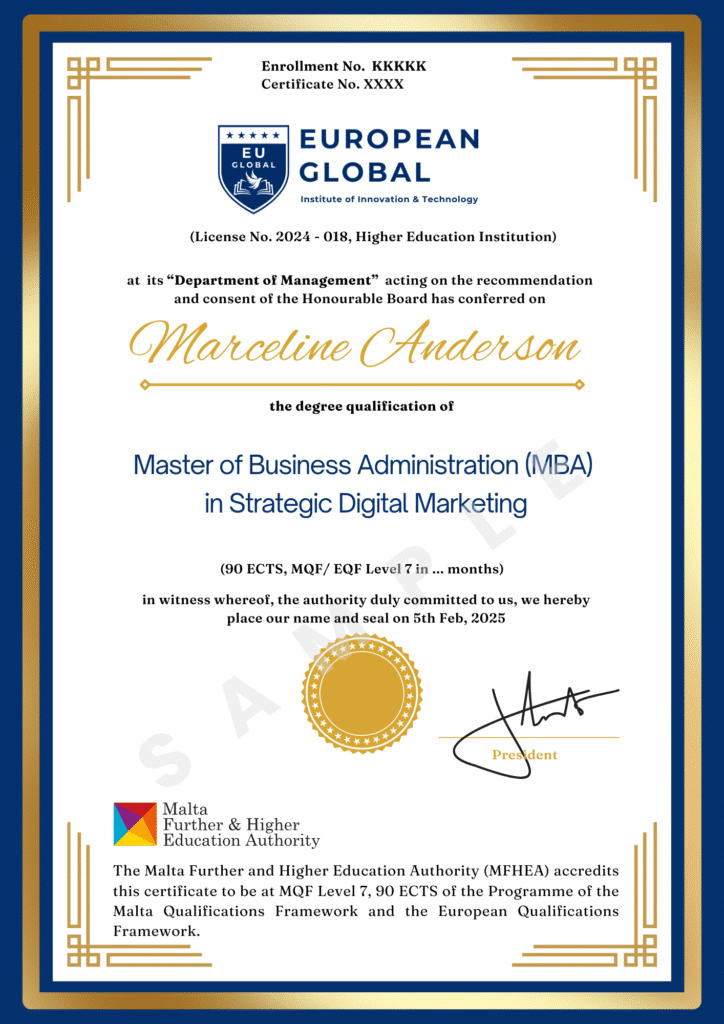
mba in digital marketing cert
Dr Chizoba Nwabunike

DR CHIZOBA NWABUNIKE FACULTY MEMBER DOCENTI GOBAL BUSINESS SCHOOL

Dr. Chizoba Nwabunike is a passionate and accomplished marketing and business leader with over 20 years of experience working across top brands in FMCG, betting, telecom, and fintech. Known for her creativity and strategic thinking, she has successfully led brand turnarounds and driven strong business growth. She holds a PhD in Business Administration, an MSc in Innovation Marketing, and an Executive MBA. As Managing Director of Rue Sage Media and Osis Foods Limited, and a Fellow of CIM, she blends deep academic knowledge with real-world leadership and executional excellence.

COURSE CONTENT (CORE MODULES 30 ECTS)

Module 1: Management and Organizational Dynamics (3 ECTS, 75 Hours)
This module delves into the core principles of management and the intricate nature of organizational behaviour within modern business settings. It highlights how effective management influences organizational culture, performance, and overall success. By integrating key theories with practical insights, students will develop the ability to analyze, interpret, and manage the various internal and external factors that drive organizational change and dynamics.

Module 2: Managing Financial Resources and Performance (3 ECTS, 75 Hours)


This module explores both the theoretical foundations and contemporary practices of financial management, including financial reporting, cost and managerial accounting, valuation, and performance analysis across diverse organizational contexts. Students will learn to apply accounting principles, tools, and frameworks to enhance decision-making and leadership effectiveness. Emphasis is placed on interpreting and utilizing financial information to assess performance and support strategic objectives in private, public, and non-profit organizations.

The module also promotes professional development through interactive learning, requiring students to engage with a range of financial data, case studies, and analytical activities. Participants will gain practical experience in preparing and analyzing financial statements, applying financial ratios and standards, and conducting forecasting, valuation, and risk assessments to support sound financial decision-making.

Module 3: Strategic and Digital Marketing (3 ECTS, 75 Hours)
In an increasingly digitalized business environment, organizations must continuously evolve their marketing approaches to connect with audiences and sustain growth. This module provides students with a strategic understanding of digital marketing principles and their application in achieving competitive advantage. It covers a wide spectrum of digital marketing tools, strategies, and frameworks, emphasizing how technology and innovation shape modern marketing practices.

Students will learn how to align digital marketing initiatives with broader business objectives and use data analytics to inform strategy, optimize performance, and strengthen customer relationships. Through practical case studies and strategic analysis, the module fosters the ability to design, implement, and manage effective digital marketing campaigns that drive measurable results and support long-term organizational success.

Module 4: Project and Operations Management (3 ECTS, 75 Hours)
This module provides an in-depth understanding of how organizations plan, manage, and optimize projects and operational processes to achieve strategic success. It equips students with the essential principles, frameworks, and analytical tools required to effectively oversee projects and operations across different business sectors.

Key areas of study include project management methodologies, operational strategy, process improvement, quality assurance, and supply chain management. Students will develop the ability to design, implement, and monitor projects to ensure timely delivery, cost efficiency, and alignment with organizational goals. The module also emphasizes the integration of operations management with business strategy, focusing on enhancing productivity, maintaining quality standards, and driving customer satisfaction through effective process and resource management.

Module 5: Financial Markets and Valuation (3 ECTS, 75 Hours)
This module provides students with a comprehensive understanding of key financial concepts and challenges faced by organizations at the strategic level. It prepares participants to effectively collaborate with finance and accounting professionals and to make informed financial decisions within diverse business contexts.

Students will explore the fundamentals of financial analysis, corporate finance, and valuation techniques, gaining insight into how financial markets operate and influence organizational strategy. The module addresses real-world financial issues relevant to both private and public sectors, with a strong emphasis on global financial dynamics. By the end of the module, students will be able to apply financial theories and analytical tools to assess value, manage risk, and solve complex financial problems in a professional environment.

Module 6: Strategic Decision Making: Dealing with Business Complexity (3 ECTS, 75 Hours)
This module explores how organizations formulate and implement strategies in complex and dynamic business environments. It emphasizes the importance of consistency, commitment, and adaptability in strategic decision-making. Students will learn to analyze environmental challenges, identify competitive advantages, and leverage organizational resources and capabilities to achieve sustainable success.

Through real-world case studies and practical examples, the module deepens students’ understanding of how strategic choices shape organizational performance and long-term positioning. It also encourages critical reflection on the dynamics of strategy, enabling students to develop the analytical and decision-making skills necessary to manage uncertainty, competition, and change effectively within diverse business contexts.

Module 7: Economics for Decision-Making (3 ECTS, 75 Hours)
This module provides students with a solid foundation in economic theory and its application to managerial decision-making. It combines key concepts from microeconomics and macroeconomics to help students understand market behaviour, policy impacts, and the broader economic forces influencing business performance.

Emphasis is placed on developing practical analytical skills that enable students to interpret economic data, evaluate market conditions, and make sound strategic choices. By applying economic reasoning to real-world business situations, students will learn how to assess risks, anticipate trends, and design effective strategies that promote organizational growth and competitiveness in an increasingly globalized economy.

Module 8: Ethical Leadership and Governance (3 ECTS, 75 Hours)
This module offers a comprehensive examination of ethical leadership principles and governance systems within modern organizational contexts. It explores the ethical responsibilities of leaders and the role of governance structures in promoting accountability, transparency, and responsible decision-making.

Students will develop the skills and mindset needed to navigate ethical dilemmas, foster integrity, and uphold professional standards in complex business environments. Through theoretical frameworks, real-world case studies, and applied learning, the module equips participants to lead ethically, implement effective governance practices, and create organizational cultures grounded in trust and ethical excellence.

Module 9: Corporate Sustainability and Leadership (3 ECTS, 75 Hours)
This module explores the principles and practices of corporate sustainability and their alignment with effective leadership in modern organizations. It focuses on how leaders can integrate environmental, social, and economic priorities into strategic decision-making to promote long-term organizational success and societal well-being.

Students will examine key sustainability frameworks, leadership models, and global case studies to understand how ethical and visionary leadership drives sustainable transformation. Emphasis is placed on addressing pressing global issues such as climate change, resource management, and social responsibility, while fostering a culture of innovation and accountability that supports sustainable growth and corporate resilience.

Module 10: Business Communication for Competitive Advantage (3 ECTS, 75 Hours)
In today’s fast-paced and interconnected business world, strong communication skills are essential for both individual and organizational success. This module focuses on developing the advanced communication and interpersonal skills required for effective leadership, teamwork, and strategic influence. It blends contemporary communication theories with real-world case studies to provide a practical and applied learning experience.

Students will refine their ability to communicate clearly and persuasively across diverse professional contexts, including written, verbal, and digital formats. The module also addresses cross-cultural communication and the strategic use of modern communication technologies. By the end of the course, participants will be able to convey ideas with confidence, adapt their communication styles to different audiences, and leverage communication as a tool for achieving competitive and professional excellence.

COURSE CONTENT (ELECTIVE MODULES 30 ECTS)

Module 1: Consumer Behaviour and Market Communications (6 ECTS, 150 Hours)
This module provides an in-depth understanding of the factors influencing consumer behaviour at both individual and organizational levels. It examines the psychological, social, and cultural determinants that shape purchasing decisions and consumption patterns. By exploring how consumers form perceptions, make choices, and respond to marketing stimuli, students will learn to apply behavioural insights to develop effective marketing and communication strategies that create lasting customer value.

The module also emphasizes critical evaluation of existing marketing practices and communication models. Students will gain practical skills in consumer research methods, data interpretation, and trend analysis, enabling them to connect behavioural insights with strategic marketing decisions. Through theoretical exploration and applied learning, participants will be equipped to design evidence-based marketing approaches that align with evolving consumer expectations and market dynamics.

Module 2: Digital and Social Media Marketing (6 ECTS, 150 Hours)
This module provides an applied understanding of digital and social media platforms and their strategic use in modern marketing. It explores key technologies and channels—including social networks, mobile applications, and online communities—and examines how they influence consumer engagement, brand perception, and marketing communication.

Students will analyze theoretical frameworks related to trust, interaction, and customer relationships while assessing emerging trends and usage patterns in the digital landscape. The module also addresses the ethical and legal dimensions of online marketing. Through a combination of theory and practical application, students will learn to design and execute effective social media strategies, leveraging data-driven insights and innovative tools to enhance brand visibility, engagement, and overall marketing performance.

Module 3: Digital Customer Experience (6 ECTS, 150 Hours)
This module focuses on the concepts and strategies behind creating meaningful and seamless digital experiences that meet the evolving expectations of today’s customers. It examines how digital transformation is redefining customer interactions and explores the tools, technologies, and frameworks that organizations use to design and deliver personalized and engaging digital journeys.

Students will learn how to analyze customer behaviour, map digital touchpoints, and implement strategies that enhance satisfaction, loyalty, and long-term engagement. Emphasis is placed on understanding the role of innovation, data, and user-centered design in optimizing digital experiences. By the end of the module, participants will be equipped to develop and manage customer experience strategies that strengthen brand relationships and drive competitive advantage in the digital marketplace.

Module 4: Strategic Brand Management (6 ECTS, 150 Hours)
This module provides an advanced understanding of the key principles and practices of brand management and the creation of brand equity. It equips students with the strategic insight and analytical tools necessary to develop, position, and sustain strong brands that align with corporate objectives. Learners will explore branding from both a strategic and marketing perspective, gaining the skills to craft effective brand strategies and manage brand performance across diverse markets and industries.

The module also focuses on maintaining brand consistency, fulfilling brand promises, and maximizing the long-term value of established brands. Through case studies and applied learning, students will analyze successful branding models, assess brand equity drivers, and learn to implement strategies that strengthen brand identity, loyalty, and competitive advantage in a dynamic global marketplace.

Module 5: Digital Marketing Analytics (6 ECTS, 150 Hours)
This module provides students with the essential knowledge and skills to evaluate, interpret, and optimize digital marketing performance through data-driven insights. It serves as a core component of digital marketing education, emphasizing the integration of analytical thinking with strategic marketing decision-making.

Students will learn how to collect and analyze digital metrics, measure campaign effectiveness, and apply analytical tools to enhance marketing outcomes. The module combines theoretical foundations with hands-on experience using industry-standard analytics platforms, enabling learners to transform data into actionable strategies. By the end of the course, participants will have developed strong problem-solving and analytical abilities, empowering them to make informed marketing decisions that improve performance and maximize return on investment.

COURSE CONTENT (RESEARCH & INNOVATION MODULES 30 ECTS)

Module 1: Innovation Management and Design Thinking for Entrepreneurs (6 ECTS, 150 Hours)
This module equips students with the knowledge and competencies to foster innovation and apply design thinking within entrepreneurial and organizational settings. It examines key concepts of innovation management, from idea generation and development to market implementation, emphasizing how creativity and strategic design can drive business growth and differentiation.

Through a blend of theory and experiential learning, students will learn to apply design thinking methodologies to address complex business challenges, enhance customer value, and promote continuous improvement. The module encourages an entrepreneurial mindset focused on experimentation, problem-solving, and user-centered innovation. By its conclusion, participants will be prepared to lead innovative projects and translate creative ideas into viable, sustainable business opportunities.

Module 2: Data-Driven Research and Analytical Insights (6 ECTS, 150 Hours)
This module develops students’ ability to design and execute robust research projects using data-driven approaches. It introduces essential research methodologies and analytical techniques that support evidence-based decision-making in business and management contexts. Students will learn how to formulate research objectives, choose suitable data collection methods, apply sampling strategies, and conduct both qualitative and quantitative analyses.

Emphasis is placed on research ethics, data integrity, and transparent reporting. The module also guides students in developing research proposals, critically reviewing existing literature, and effectively communicating analytical findings. By the end of the course, participants will be equipped with the methodological and analytical skills needed to generate meaningful insights and support strategic decision-making through applied research.

Module 3: Capstone Consulting Project (18 ECTS, 450 Hours)
The Capstone Consulting Project serves as the final integrative component of the MBA program, allowing students to apply the knowledge, frameworks, and skills developed throughout their studies to real-world business challenges. Working individually or in teams, participants will collaborate with organizations to analyze complex business issues and develop strategic, evidence-based solutions that deliver measurable value.

This module emphasizes advanced problem-solving, analytical thinking, teamwork, and professional communication. Through practical engagement, students will refine their consulting capabilities and demonstrate their leadership potential in a professional setting. For on-campus learners, the project may be undertaken in conjunction with an internship, offering additional opportunities to gain hands-on industry experience and enhance employability.

Accreditation and Recognition

EU Global logo
wes
ECTS
Malta Further
APHE
ECTS