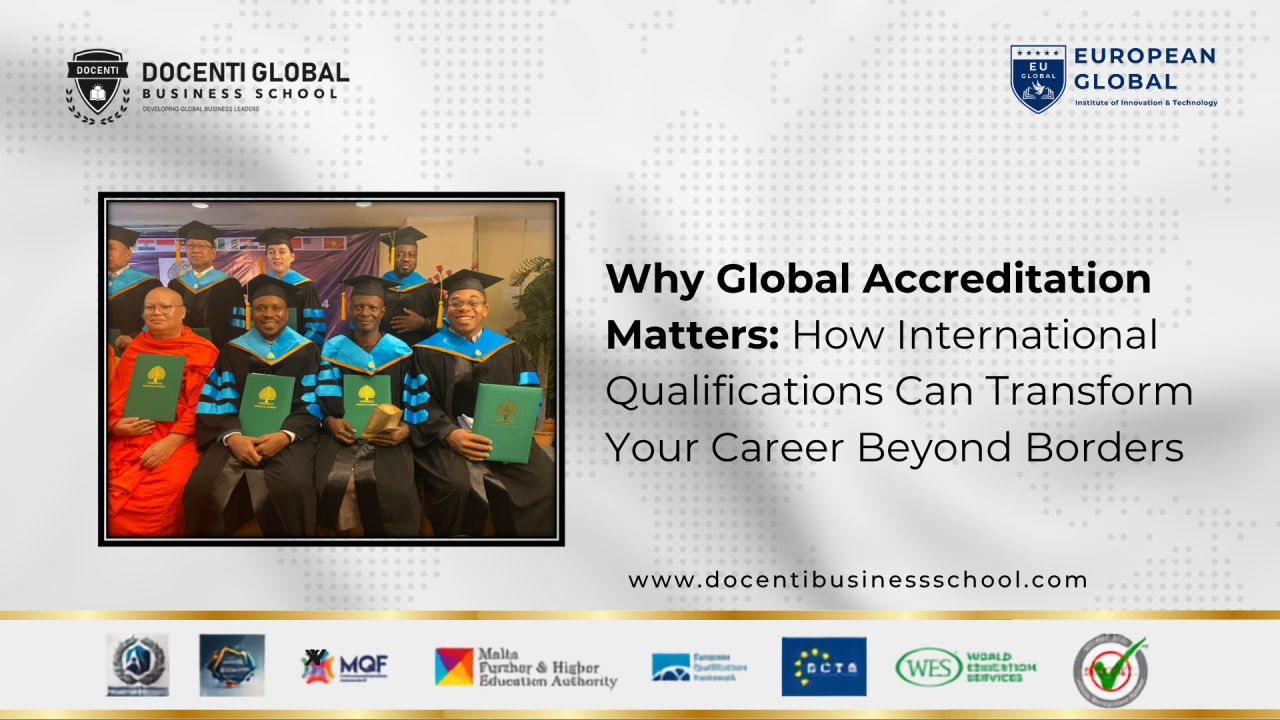
Why Global Accreditation Matters: How International Qualifications Can Transform Your Career Beyond Borders
Education Is No Longer Limited by Geography
The world of work has changed dramatically over the past decade. Organizations now recruit talent across borders, multinational companies build globally distributed teams, and professionals increasingly compete in an international labour market. As a result, earning a qualification is no longer just about obtaining a certificate—it is about ensuring that your education is recognized, respected, and relevant wherever your career takes you.
For prospective students in Nigeria and across Africa, one question has become increasingly important:
“Will my qualification be recognized beyond my country?”
This is where global accreditation becomes a critical factor.
Whether you are pursuing an MBA, a Master’s degree, executive education, or a professional diploma, choosing an institution with internationally recognized standards can influence your employability, career progression, professional credibility, and long-term return on investment.
This article explains what global accreditation means, why it matters, and how internationally recognized qualifications can unlock opportunities far beyond national borders.

The Global Shift Toward International Education
Today’s employers are looking for professionals who possess more than academic knowledge. They want graduates who can think strategically, solve complex business problems, adapt to changing technologies, and operate confidently in multicultural environments.
Globalization, digital transformation, and remote work have created an interconnected workforce where employers compare candidates from different countries based on competence—not geography.
Consequently, internationally recognized education has become a competitive advantage rather than a luxury.
Professionals who graduate from institutions aligned with recognized international quality standards often demonstrate greater readiness for leadership, innovation, and global collaboration.
What Accreditation Actually Means
Accreditation is an independent quality assurance process that evaluates whether an educational institution or programme meets established academic and professional standards.
Rather than simply approving a curriculum, accreditation examines multiple aspects of institutional quality, including:
- Academic governance
- Curriculum relevance
- Faculty expertise
- Assessment methods
- Student support
- Learning resources
- Ethical standards
- Continuous quality improvement
- Industry relevance
- Graduate outcomes
Accreditation provides confidence to students, employers, and professional bodies that an institution delivers education consistent with recognized quality benchmarks.
Simply put, accreditation is evidence that a qualification has been developed, delivered, and assessed according to defined standards of excellence.
Why Accreditation Matters More Than Ever
As higher education expands globally, students have more choices than ever before. However, not every institution maintains the same academic standards.
Choosing an accredited institution helps reduce uncertainty by ensuring that the education you receive has been independently evaluated for quality and relevance.
For employers, accreditation provides reassurance that graduates have completed programmes designed around recognized academic and professional expectations.
For students, it offers confidence that their investment in education is supported by credible quality assurance.
Local Recognition vs International Recognition: Understanding the Difference
One of the most misunderstood aspects of higher education is the distinction between local recognition and international recognition.
Local Recognition
Local recognition generally demonstrates that an institution operates within the legal and regulatory framework of its country.
It is important because it confirms that the institution meets national educational requirements.
However, local recognition alone does not automatically indicate how widely a qualification may be understood or valued by employers, professional bodies, or institutions in other countries.
International Recognition
International recognition extends beyond national borders.
It reflects alignment with internationally respected quality standards, partnerships, professional bodies, or accreditation frameworks that support broader academic and professional credibility.
For professionals planning careers with multinational organizations, international NGOs, global consulting firms, technology companies, or cross-border businesses, internationally recognized qualifications can strengthen confidence in the quality and relevance of their education.
Understanding European Qualification Frameworks
Europe has developed comprehensive quality assurance systems designed to promote transparency, consistency, and trust in higher education.
These frameworks encourage institutions to focus on:
- Learning outcomes
- Academic integrity
- Student-centred education
- Continuous quality improvement
- Research excellence
- Employability
- International collaboration
Many European qualifications emphasize practical learning alongside theoretical knowledge, ensuring graduates are prepared to solve real business challenges.
For African professionals seeking education with international relevance, programmes aligned with recognized European academic principles can provide valuable exposure to global best practices and internationally oriented business thinking.
Why Employers Value Internationally Recognized Qualifications
Recruiters rarely hire candidates solely because of a certificate. They hire professionals who demonstrate competence, credibility, and the ability to contribute effectively from day one.
Internationally recognized qualifications often signal that graduates have been exposed to:
- Global business environments
- International case studies
- Strategic leadership principles
- Cross-cultural communication
- Digital transformation
- Innovation management
- Evidence-based decision-making
These competencies are increasingly important in organizations operating across multiple markets.
For multinational employers, internationally aligned education can also make it easier to understand the academic context of a candidate’s qualification.
International Mobility: Expanding Career Opportunities Beyond Borders
The modern professional career is no longer confined to one city or one country.
African professionals now work with organizations based in Europe, North America, the Middle East, Asia, and other parts of Africa without necessarily relocating.
Remote work, international consulting, cross-border entrepreneurship, and multinational business have transformed career mobility.
Professionals with internationally recognized education may find themselves better positioned to pursue opportunities such as:
- Regional leadership roles
- International consulting assignments
- Cross-border business development
- Global technology companies
- International NGOs
- Remote employment
- Doctoral research
- Executive leadership programmes
While accreditation alone does not guarantee employment or immigration outcomes, it can enhance the credibility of your educational background in international contexts.
Professional Credibility: Building Trust Before You Speak
Professional credibility is often established before an interview begins.
Employers, clients, investors, and collaborators frequently review educational qualifications when evaluating expertise.
Graduating from an institution that maintains internationally recognized quality standards can strengthen professional confidence because it demonstrates a commitment to academic excellence and continuous learning.
For entrepreneurs, consultants, executives, and business leaders, credibility often influences:
- Client confidence
- Partnership opportunities
- Investor trust
- Speaking invitations
- Advisory positions
- Leadership appointments
Education becomes part of your professional brand.
The Return on Investment (ROI) of Internationally Accredited Education
Higher education should not be viewed solely as an academic achievement—it is also a long-term investment in your career.
The value of that investment depends on several factors:
1. Career Advancement
Internationally relevant qualifications can support progression into leadership and specialist roles.
2. Employability
Employers increasingly value graduates who combine technical knowledge with global perspectives.
3. Professional Network
Internationally connected institutions often provide opportunities to engage with faculty, peers, alumni, and industry experts from diverse backgrounds.
4. Lifelong Learning
Exposure to global standards encourages continuous professional development and adaptability.
5. Leadership Readiness
International programmes often emphasize critical thinking, innovation, ethical leadership, and strategic decision-making—skills that remain valuable across industries.
The greatest return on investment is not simply higher earnings; it is increased career resilience and long-term professional relevance.
Common Misconceptions About Accreditation
Misconception 1: “All Degrees Are Equal”
Not all qualifications are developed under the same quality assurance processes. Accreditation helps distinguish programmes that have undergone independent evaluation.
Misconception 2: “Accreditation Guarantees a Job”
No qualification can guarantee employment.
However, accredited education can strengthen your profile by demonstrating that your learning aligns with recognized academic and professional standards.
Misconception 3: “Only International Universities Can Offer Globally Relevant Education”
Many institutions outside Europe and North America deliver programmes that are internationally aligned through recognized partnerships, quality assurance frameworks, and professional collaborations.
Students can access globally relevant education without necessarily studying overseas.
Misconception 4: “Accreditation Only Matters for Academic Careers”
Accreditation benefits professionals across industries, including business, healthcare, technology, finance, consulting, engineering, and entrepreneurship.
Employers increasingly value quality assurance regardless of sector.
Why Choosing the Right Business School Matters
Selecting a business school involves more than comparing tuition fees or programme duration.
Prospective students should evaluate:
- Academic quality
- Faculty expertise
- Industry relevance
- Global partnerships
- Student support
- Learning flexibility
- Alumni network
- Leadership development
- Professional recognition
- Commitment to continuous improvement
The right institution prepares graduates not only for today’s challenges but also for tomorrow’s opportunities.
Docenti Global Business School: Preparing Professionals for a Global Economy
At Docenti Global Business School (DGBS), our approach to education is built on the belief that professionals should graduate with knowledge that is relevant across industries and increasingly connected global markets.
Through internationally focused curricula, industry-driven learning, and strategic partnerships, DGBS equips students with practical skills that support career advancement in business, technology, healthcare, leadership, and digital transformation.
Our portfolio includes:
- MBA programmes across multiple specializations
- Master’s programmes
- Executive education
- Diploma programmes in Data Science and Cybersecurity
- Doctoral pathways
- Professional development programmes
DGBS is committed to maintaining quality standards through international collaborations and recognized accreditation relationships that reinforce academic excellence and professional relevance. Prospective students are encouraged to review the institution’s current accreditation status and partnerships directly through official school channels as part of their enrollment decision.
Education That Travels With You
The future of work is global, interconnected, and increasingly competitive. Employers are looking for professionals who combine technical expertise with strategic thinking, ethical leadership, and an international outlook.
Choosing an institution with internationally recognized quality standards is not simply about earning a qualification—it is about investing in credibility, adaptability, and long-term career growth.
Whether your ambition is to lead a multinational organization, build a successful business, transition into an international career, or advance within your current profession, globally relevant education provides a stronger foundation for success.
In a world where opportunities increasingly cross borders, your qualification should be ready to do the same.
The most valuable education is not only the one that helps you graduate—it is the one that continues to create opportunities wherever your career leads.
Explore Our Programs

The DBA Program at Docenti Global Business School is designed for professionals and executives looking to strengthen their leadership, research, and strategic business skills for higher-level career and management opportunities.

The Employability Skills Development Program at Docenti Global Business School helps students and professionals develop practical workplace skills, communication abilities, leadership qualities, and career readiness for today’s job market.
Read more